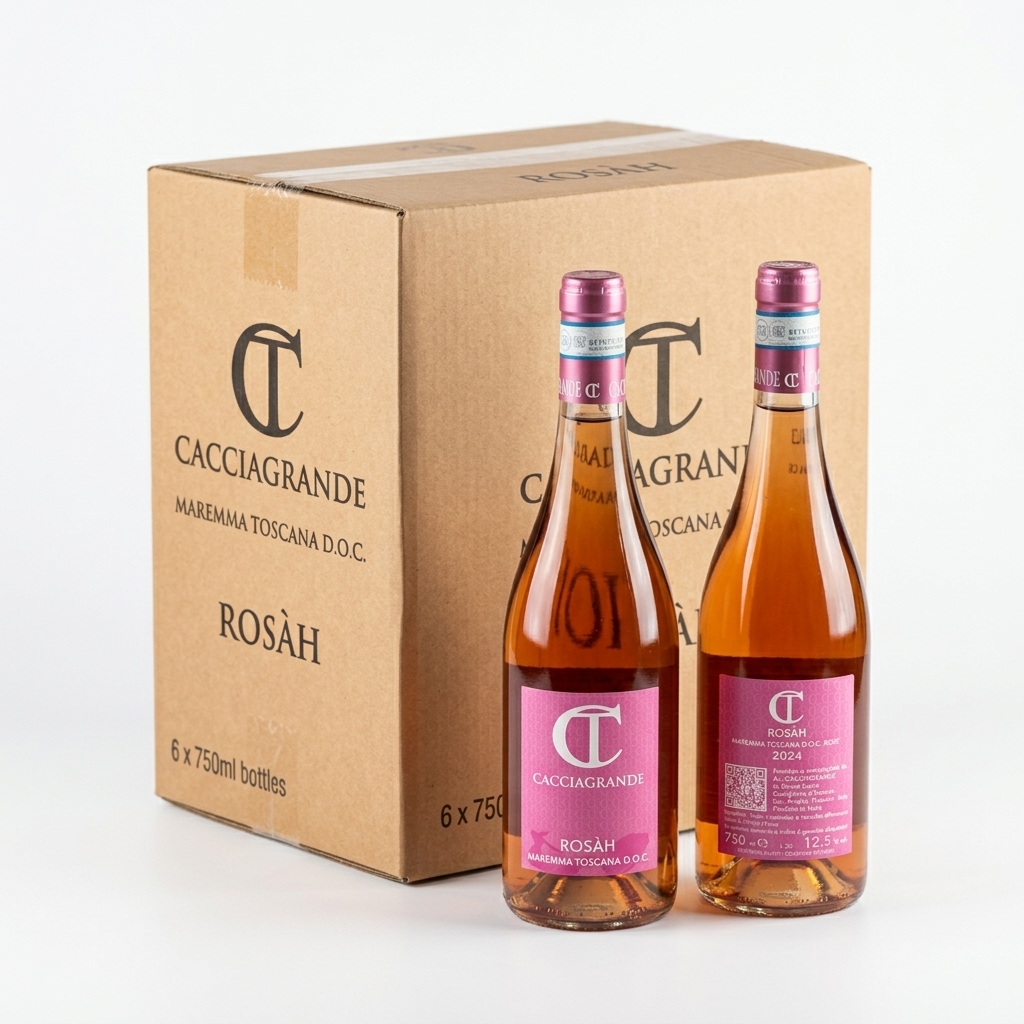
Rosàh is the DOC Maremma Toscana rosé by Cacciagrande: a Syrah-based pink wine from Castiglione della Pescaia, on the Tuscan coast. Vintage 2024, 12.5% vol, 750 ml bottle, limited production of around 12,000 bottles per year. Fresh, savoury and fruit-driven, it is built for aperitifs, seafood and summer menus — and available in Switzerland through LAPA with B2B and B2C delivery.
What Is Rosàh
Rosàh is a still rosé wine produced under the Maremma Toscana DOC appellation, obtained from Syrah grapes vinified in rose. The style is ultra-fresh: aromas of strawberry, pomegranate and pink grapefruit, a savoury saline palate and a clean, dry finish. The winery itself describes it as an ideal summer wine, designed for the table rather than for long ageing.
The Cacciagrande Winery
Azienda Vitivinicola Cacciagrande was founded in 1997 by the Tuccio family, about 10 kilometres from the medieval seaside town of Castiglione della Pescaia, between the village of Tirli and the Etruscan site of Vetulonia. The estate covers roughly 40 hectares, of which 18 are planted with vines and 4 with olive groves, combining the Tuscan tradition of Sangiovese with international varieties such as Syrah, Cabernet Sauvignon, Merlot and Petit Verdot.
A Mediterranean Terroir
The vineyards grow on mineral soils a few kilometres from the Tyrrhenian Sea, surrounded by Mediterranean scrub and ventilated by the dry mistral breeze. These conditions — sea proximity, mineral soils, constant wind — are frequently compared to those of Bolgheri, the most celebrated coastal wine area of Tuscany. The maritime climate preserves acidity in the grapes, which is the backbone of this rosé.
Tasting Profile
Pale pink colour. The nose opens on strawberry and pomegranate, with a distinctive note of pink grapefruit. The palate is dry, vertical and saline, with medium body at 12.5% vol and a thirst-quenching finish. Serve at 10-12 °C in a medium white-wine glass.
Professional Uses and Pairings
On a restaurant list, Rosàh works as a by-the-glass aperitif and as a pairing wine for raw fish and crudités of the day, shellfish and crustaceans, fried fish, summer salads, vitello tonnato and white pizzas with burrata or prawns. For banqueting, plan one 750 ml bottle for 5-6 aperitif pours of 120-140 ml. Open just before service and keep in ice at 10-12 °C; avoid serving below 8 °C, which mutes the fruit.
Common Mistakes to Avoid
Do not store the bottles upright in a warm back room: keep them lying down, in the dark, at 12-16 °C. Do not carry the rosé over to the next season — a 2024 vintage expresses its fruit best within 2 years. Do not treat it as a sweet wine on the menu: Rosàh is dry and gastronomic, and should be listed with the still rosés, not with dessert wines.
Distribution and Logistics in Switzerland
B2B and B2C delivery throughout Switzerland from the climate-controlled LAPA warehouse in Embrach (Zurich), where wines rest at constant cellar temperature. Direct LAPA fleet across Zurich, Winterthur, Kloten, Aargau, St. Gallen, Lucerne, Bern and Basel. For Ticino (Lugano, Locarno), French-speaking Switzerland (Geneva, Lausanne, Montreux) and mountain regions (Chur, Davos, St. Moritz) delivery within 24-48 hours via partner couriers such as Swiss Post, Planzer and Galliker. Bottles travel protected and lying down.
Who It Is For
Italian restaurants and trattorias building a regional Tuscan list, pizzerias offering a fresh by-the-glass rosé, hotels and beach bars with summer terraces, wine shops and delicatessens looking for a limited-production label, caterers for weddings and summer events, and private customers who love authentic Italian wine. With about 12,000 bottles produced per year, Rosàh is a niche reference, not a commodity rosé.