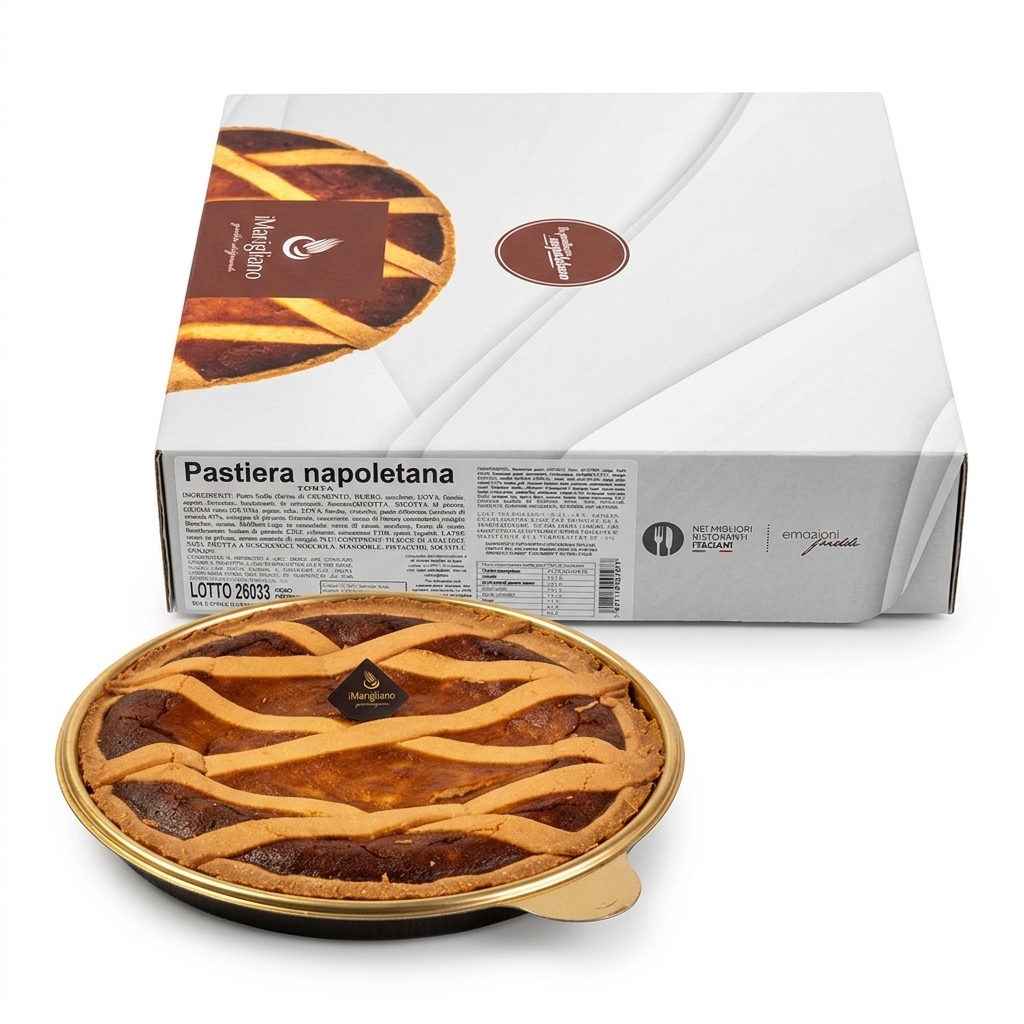
La Pastiera Napoletana de Dolciaria Marigliano est le dessert pascal napolitain par excellence : une croûte de pâte brisée croustillante enferme une garniture de ricotta, de blé cuit et de fleur d'oranger. Ce gâteau surgelé de 1,4 kg est fabriqué en Campanie et arrive prêt à décongeler et servir, pour 12-16 portions d'environ 90-110 g chacune. Conservation à -18 °C, durée de conservation 300 jours, allergènes gluten, œufs et lait.
Qu'est-ce que la Pastiera Napoletana
La pastiera est une tarte cuite au four dans laquelle une pâte brisée parfumée enferme une garniture crémeuse de ricotta de brebis, de blé cuit, de sucre et du parfum incomparable de fleur d'oranger. C'est le dessert symbolique de Pâques napolitaines, mais sa qualité et sa longue conservation en tant que produit surgelé en font une référence toute l'année pour les cuisines professionnelles. Chaque gâteau pèse 1,4 kg net.
Histoire et origine
La pastiera est documentée dans les festivités pascales napolitaines depuis le XVIIe siècle : Giambattista Basile la mentionne dans La gatta Cenerentola, et en 1866 Francesco de Bourcard la décrit dans Usi e costumi di Napoli comme le couronnement du banquet festif. L'utilisation du blé cuit dans la garniture porte une valeur symbolique ancienne liée aux cultes gréco-romains de la fertilité de Cérès, célébrés à l'équinoxe de printemps. La recette moderne est traditionnellement attribuée aux religieuses bénédictines du couvent de San Gregorio Armeno à Naples, tandis que la légende populaire l'attribue à la sirène Parthénope.
Le producteur : Dolciaria Marigliano
Dolciaria Marigliano SRL produit depuis 2006 des produits de boulangerie ainsi que de la pâtisserie fraîche et surgelée à San Giuseppe Vesuviano, au pied du Vésuve près de Naples. L'entreprise est spécialisée dans les gâteaux, semifreddi et desserts surgelés pour le marché italien et l'export, avec un suivi HACCP continu de la chaîne du froid. La pastiera reflète la tradition pâtissière campanienne transposée dans un format surgelé stable et professionnel.
Profil organoleptique
La croûte de pâte brisée est dorée et friable ; la garniture est dense et crémeuse, équilibrée entre la note lactée de la ricotta, la texture des grains de blé cuit et l'arôme floral et agrumé de la fleur d'oranger. Servie correctement à température ambiante, les matières grasses de la ricotta s'assouplissent et les arômes d'agrumes deviennent volatils et expressifs.
Spécifications techniques
Poids net 1,4 kg. Produit surgelé, conservé à -18 °C, avec une tolérance de transport maximale de plus ou moins 3 °C (produit jamais au-dessus de -15 °C). Durée de conservation commerciale 300 jours à compter de la production. Ingrédients à base de pâte brisée, ricotta, blé cuit, œufs et arômes naturels. Allergènes : céréales contenant du gluten (blé, blé cuit), œufs et lait ; peut contenir des traces d'arachides, soja, fruits à coque, noisette, amandes, pistaches, sulfites et moutarde.
Utilisations professionnelles
Idéal pour le chariot à desserts, la fin de repas et le comptoir du bar. Décongeler le gâteau entier lentement au réfrigérateur à 0-4 °C, puis le portionner en 12-16 tranches et amener chaque tranche à température ambiante avant de servir. Excellent dressé avec un voile de sucre glace, accompagné d'un espresso ou d'un verre de passito, ou proposé en portion individuelle pour le petit-déjeuner et le service pâtisserie de l'après-midi.
Accords
S'accorde naturellement avec une liqueur douce comme l'Alchermes, badigeonnée légèrement sur la tranche selon la tradition napolitaine, ou avec un verre de Limoncello ou de vin doux. Au comptoir pâtisserie, elle se marie bien avec d'autres desserts italiens et spécialités de boulangerie napolitaines.
Erreurs courantes à éviter
Ne jamais servir la pastiera directement sortie du réfrigérateur à 4 °C : le froid anesthésie le palais, solidifie les graisses nobles de la ricotta et bloque la volatilité des arômes de fleur d'oranger. Ne jamais recongéler un gâteau décongelé, tant pour la sécurité alimentaire que pour la texture. Ne pas confondre la pastiera avec le migliaccio, un gâteau de carnaval campanien qui utilise de la semoule au lieu de grains de blé cuit.
Logistique et livraison par LAPA
LAPA distribue de la pâtisserie napolitaine surgelée dans toute la Suisse depuis son entrepôt central climatisé d'Embrach (Zurich), en maintenant rigoureusement la chaîne du froid à -18 °C. La flotte multi-températures propre à LAPA dessert Zurich, Winterthur, Uster, Dübendorf, Saint-Gall, Frauenfeld, Berne, Bâle et Lucerne. Pour le Tessin (Lugano, Bellinzone, Locarno, Mendrisio), la Suisse romande (Genève, Lausanne, Fribourg, Sion) et les Grisons (Coire, Davos, Saint-Moritz), l'expédition surgelée sécurisée est garantie en 24-48 heures via des transporteurs partenaires agréés pour le transport alimentaire (La Poste Suisse Frigo-Express, Planzer, Galliker, Camion Transport).
À qui s'adresse ce produit
Conçu pour les restaurants, pizzerias, épiceries fines, hôtels, bars, pâtisseries et épiceries italiennes, ainsi que pour les particuliers, à la recherche d'un authentique dessert pascal napolitain disponible toute l'année dans un format surgelé fiable.