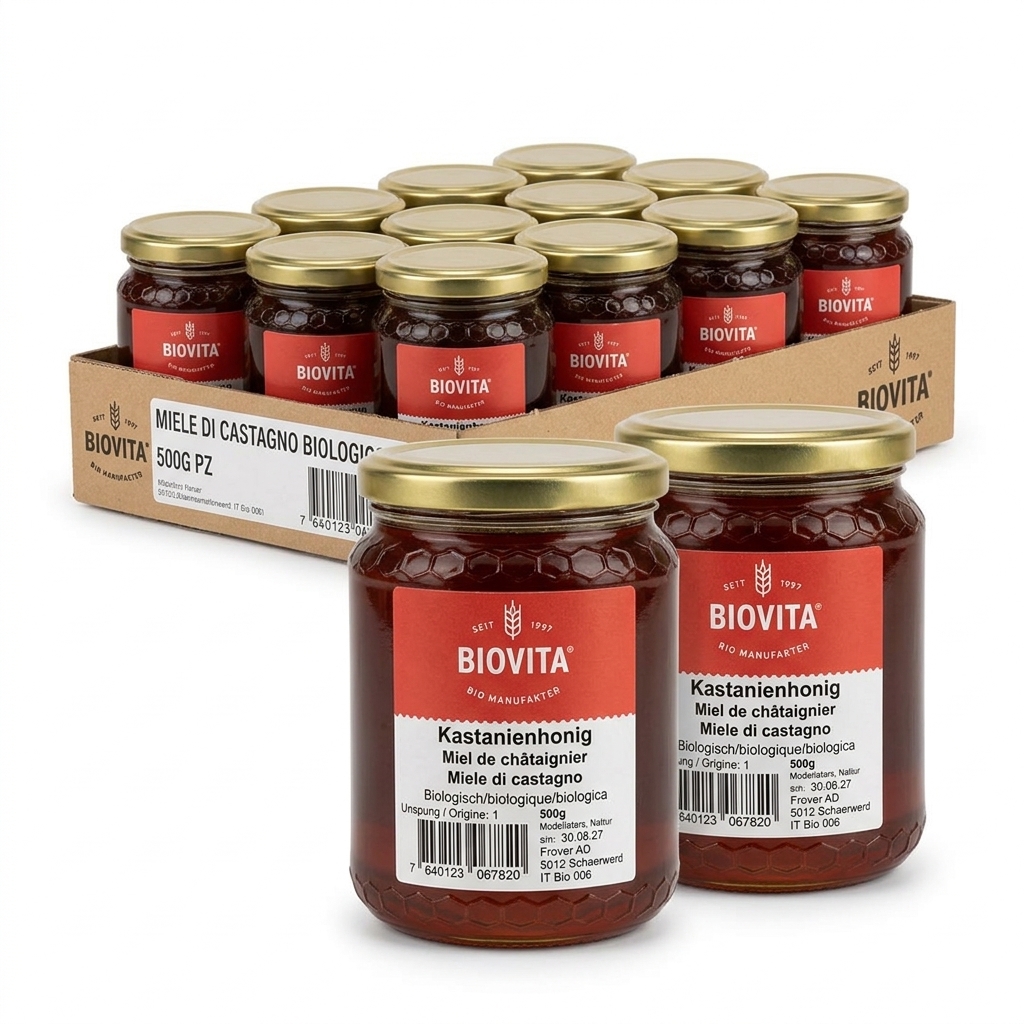
Organic Chestnut Honey: a chef's honey
Organic chestnut honey is a monofloral honey from the flowers of Castanea sativa, with a dark amber colour, an intense woody aroma and a bold, persistent taste marked by a typical slightly bitter note. This 500 g glass jar is certified organic (control body ICEA, code IT BIO 006) and comes from Italy. Unlike delicate blossom honeys, it is a structured, savoury-leaning honey that works as a cooking ingredient rather than a simple sweetener.
What is chestnut honey
Chestnut honey has been harvested across Mediterranean Europe for centuries, wherever sweet chestnut woods grow. Bees collect the nectar during the late chestnut bloom, between June and July. The result is one of the most recognisable honeys in the world: strongly aromatic, amber to dark brown, with a finish that is bitter rather than sugary. Because of its naturally high fructose content it stays fluid for a long time and crystallises very slowly, which makes it easy to portion and drizzle in a professional kitchen.
Origin and certification
This honey is produced in Italy from chestnut woods that thrive on the Apennines and the hills of central and southern Italy. The organic certification is guaranteed by ICEA (Istituto per la Certificazione Etica e Ambientale), one of Italy's main organic control bodies, under the code IT BIO 006: it certifies beekeeping free from synthetic treatments and hives sited away from intensive agriculture. Distribution in Switzerland is handled through Prodega/Transgourmet.
Sensory profile
Colour: amber to dark brown. Aroma: intense, woody, balsamic, with notes of tannin and dried wood. Taste: full-bodied and aromatic, with the unmistakable bitter aftertaste that is the signature of true chestnut honey. Texture: fluid and slow to crystallise thanks to the high fructose-to-glucose ratio. A small amount goes a long way: its persistence means it stands up to strong ingredients without being covered.
Professional uses
Chestnut honey shines in savoury pairings. Five chef-level ideas:
- Cheese boards: drizzle over aged pecorino, gorgonzola and goat cheeses; the bitterness balances the salt and fat. Dose 10-15 g per portion.
- Warm cheeses: a thread over warm ricotta, robiola or baked tomino, finished with crushed walnuts.
- Roasts and game: brush into glazes for pork, duck and venison in the last minutes of cooking for a lacquered, bittersweet crust.
- Marinades and sauces: add depth to sweet-and-sour reductions, vinaigrettes and pan sauces (1 teaspoon per 200 ml).
- Pastry: use in rustic cakes, biscuits and custard gelato, or pair with chestnuts and dried fruit for autumn desserts.
Pairings
Chestnut honey pairs naturally with aged and blue cheeses, cured meats, walnuts and chestnuts, structured red wines and aged cheeses on a tasting board. Combine it on the shelf with pecorino, gorgonzola, taralli or rustic bread, and dried fruit to build a complete savoury offer.
Storage
Store the jar in a cool, dry place, away from heat and direct light; no refrigeration is needed. Once opened, keep the lid tightly closed and use a clean, dry spoon. Slow natural crystallisation or a slight separation does not affect quality: gently warm the jar in a bain-marie below 40 degrees to bring it back to a fluid state without losing aroma.
Delivery and logistics
B2B and B2C delivery throughout Switzerland from the LAPA warehouse in Embrach (Zurich). Ambient distribution across Zurich, Winterthur, Uster, Schaffhausen, St. Gallen, Aargau, Lucerne and Basel. For Ticino (Lugano, Bellinzona, Locarno), French-speaking Switzerland (Geneva, Lausanne, Vevey, Sion), Valais and mountain regions (Davos, St. Moritz, Chur) delivery within 24-48 hours via certified couriers (Swiss Post, Planzer, Galliker, Camion Transport). Shelf-stable product, ideal for stock orders. Service tailored for restaurants, pizzerias, delicatessens, hotels, gelato shops, pastry labs, Italian grocery stores and private customers passionate about Italian cuisine.
Who it is for
Designed for chefs and food professionals who want a certified organic monofloral honey with real character: an ingredient for cheese courses, savoury dishes and signature desserts, not just a sweetener.