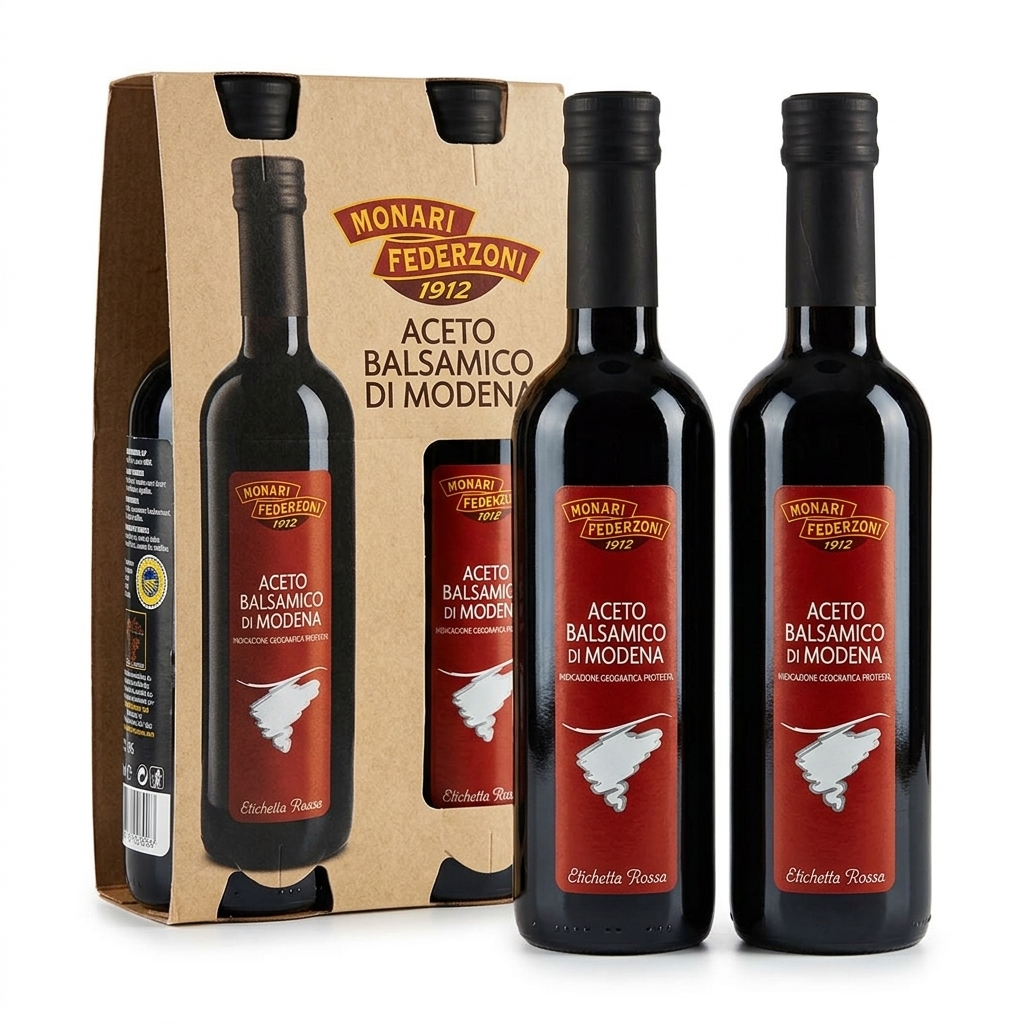


Balsamic Vinegar 500 ml — Professional Format
Balsamic vinegar in a 500 ml bottle, supplied in a carton of two bottles for professional kitchens. It is a sweet-and-sour condiment built on cooked grape must and wine vinegar, used cold as a finishing touch on salads, grilled vegetables, aged cheese, roast beef and fresh fruit. One 500 ml bottle covers roughly 50 to 100 plates at 5 to 10 ml per serving, which makes it the standard working bottle for a la carte service, buffet stations and daily dressing preparation. LAPA delivers it to restaurants, pizzerias, hotels, delicatessens and food retailers across Switzerland.
What Balsamic Vinegar Is
Balsamic vinegar is obtained from cooked and/or concentrated grape must, partially fermented, blended with wine vinegar and matured in wood. Cooking the must concentrates sugars and gives the product its dark colour, its density and the rounded sweet-and-sour balance that separates it from a plain wine vinegar. The result is a condiment with a syrupy body, a low sharpness on the palate and an aromatic profile of ripe fruit, dried figs and wood. In professional kitchens it works as a seasoning and as a decorative element, not as an acidifier: a few drops change the balance of a dish without flattening it under acidity.
Origins and History
The tradition of cooked must condiments belongs to the provinces of Modena and Reggio Emilia, in Emilia-Romagna, where families have been cooking grape must and ageing it in wooden barrels for centuries. The industrial history of the category starts at the beginning of the twentieth century: the first official production licences in Modena date to 1912. The European Union recognised Balsamic Vinegar of Modena as a Protected Geographical Indication with Regulation (EC) 583/2009, a framework now consolidated under Regulation (EU) 2024/1143. Traditional Balsamic Vinegar of Modena PDO is a different product: it is made from cooked must alone and aged for a minimum of twelve years, which is why it belongs to a completely different price bracket.
How to Recognise Balsamic Vinegar of Modena PGI
The PGI specification is strict and worth knowing when you compare offers. The must must come from Lambrusco, Trebbiano, Ancellotta, Albana, Sangiovese, Fortana or Montuni grapes; wine vinegar must account for at least 10 per cent and at least 20 per cent must be vinegar aged for ten years; caramel E150d is allowed up to 2 per cent; maturation in wood lasts a minimum of 60 days; total acidity is at least 6 per cent and density at 20 degrees Celsius is not below 1.06; production, maturation and ageing must take place in the provinces of Modena and Reggio Emilia. Products labelled simply as balsamic dressing or condiment fall outside this specification. The European Court of Justice confirmed in case C-432/18 that protection covers the full name and not the generic words taken separately.
Professional Uses
Five uses cover most of the service. First, raw dressing on green salads, tomatoes and mozzarella, added at the end with oil and salt, roughly 5 to 10 ml per plate. Second, finishing grilled or roasted meat, poured over the sliced meat off the heat so the aromatics survive. Third, the classic pairing with aged cheese, a few drops on Parmigiano Reggiano flakes as an aperitif plate. Fourth, grilled and roasted vegetables, where the sweetness balances the bitterness of radicchio, aubergine and courgette. Fifth, dessert service: strawberries, peaches and vanilla ice cream, where balsamic acts as a counterpoint to sugar rather than as a sour note.
Common Mistakes to Avoid
Three mistakes ruin both product and margin. Cooking it for a long time or at high temperature burns off the volatile aromatics and leaves only acidity, so it goes in off the heat. Treating it like a wine vinegar and pouring it by the tablespoon flattens the dish and empties the bottle: it is a concentrated sweet-and-sour condiment, it works by drops. Confusing the PGI with the Traditional PDO, or with a generic balsamic dressing, leads to buying and menu decisions that do not match the product actually served.
Pairings and Menu Ideas
Balsamic vinegar pairs naturally with Parmigiano Reggiano and other long-aged cheeses, with cured meats, with extra virgin olive oil in a simple emulsion, with fresh tomatoes and basil, and with red fruit. On a menu it supports a caprese salad, a beef tagliata, a vitello tonnato served with a drizzle, grilled vegetable antipasti and a strawberry dessert. Behind the bar it also works in low-alcohol mixing and in shrubs, where its sweet-and-sour profile replaces part of the sugar syrup.
Storage and Handling
Store the bottle upright in a cool, dry place away from direct light and heat sources. Refrigeration is not required and is not recommended, because cold thickens the product and dulls the aromatics. Close the cap after every service to limit oxidation. A natural sediment may appear at the bottom of the bottle over time: it is a normal consequence of a product based on cooked must and it does not indicate spoilage. Always read the label for the specific best-before date and for the sulphite declaration.
Distribution and Logistics in Switzerland
LAPA operates from Embrach in the canton of Zurich with its own refrigerated and ambient-temperature fleet, serving Zurich, Winterthur, Basel, Bern, Lucerne, St. Gallen, Zug, Aarau, Schaffhausen, Chur and Lugano. Areas outside the direct delivery rounds are covered through Swiss Post, Planzer, Galliker and Camion Transport. Customers include restaurants, pizzerias, hotels, gastronomies, delicatessens, ice cream parlours, pastry shops and Italian food retailers, as well as private customers ordering online.
Who It Is For
This 500 ml format in a two-bottle carton is designed for kitchens that use balsamic vinegar every day but want to keep an open bottle fresh: trattorias and pizzerias, hotel breakfast and buffet services, catering companies, delicatessen counters and bar kitchens preparing salads and cold plates. For sites with very high consumption, larger formats and balsamic glazes reduce the cost per plate and speed up plating.
Product Specifications
- Type: Balsamic vinegar, sweet-and-sour condiment based on cooked grape must and wine vinegar
- Content: 500 ml bottle
- Packaging: Carton of 2 bottles
- Net weight: 0.5 kg per bottle
- Country of origin: Italy
- Storage: Cool and dry place, away from direct light; refrigeration not required
- Usage: Cold seasoning and finishing; add off the heat
- Application sectors: Restaurants, pizzerias, hotels, catering, delicatessens, retail
- EAN code: 8003185008085
- HS customs code: 2209.00
- Note: Ingredients, acidity and nutritional values are declared on the product label
Specifications
| Brand | Ristoris |
Alternative Products
These other products might interest you