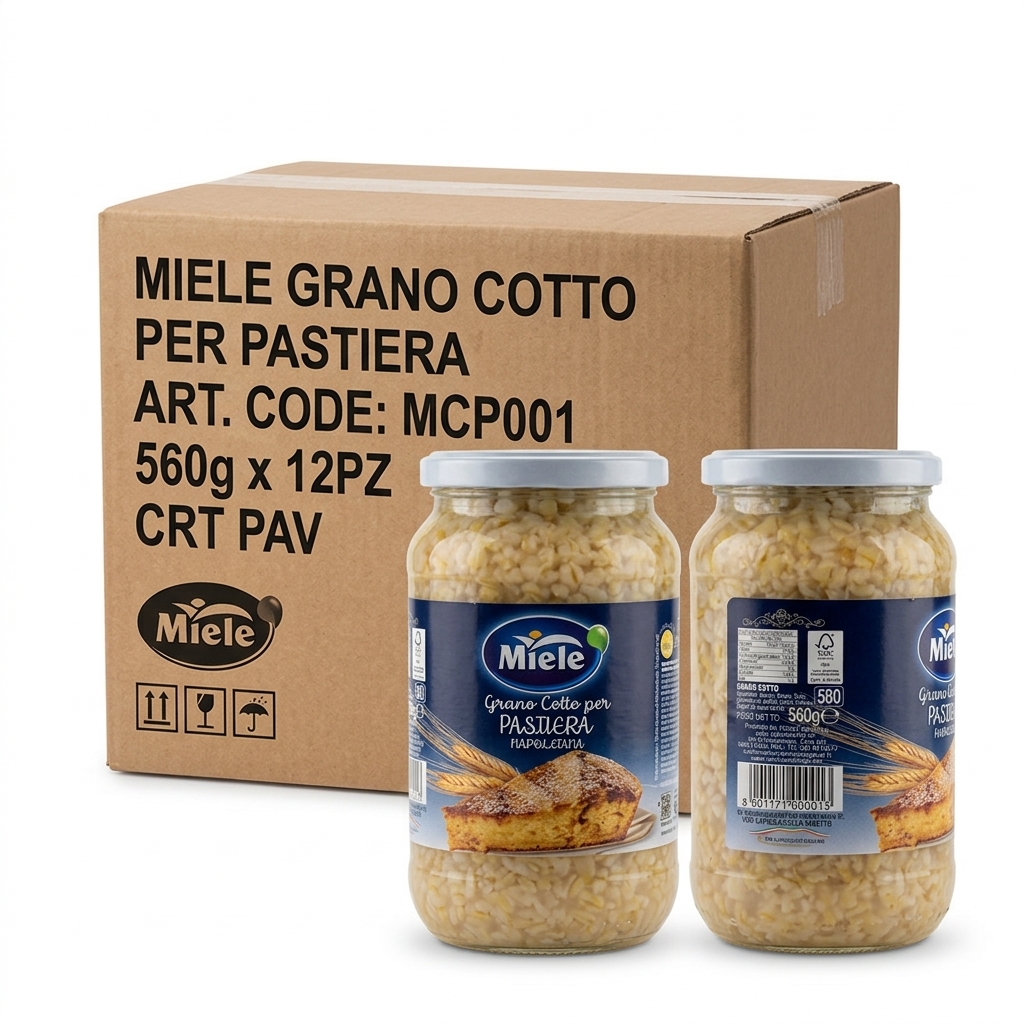
Cooked Wheat for Pastiera — 560 g Jar, Carton of 12
Cooked wheat in a glass jar, net weight 560 g in a 580 ml jar, supplied in cartons of twelve. It is the ready-to-use base of the Neapolitan pastiera: wheat grains already softened in water with salt and a touch of citric acid, so the pastry chef skips the three days of soaking and boiling that the traditional method requires. Ingredients are wheat, water, salt and citric acid, nothing else, and the label declares 100 per cent Italian product. LAPA supplies it to pastry shops, Italian bakeries and restaurants across Switzerland, with stock planned ahead of the Easter season.
What Cooked Wheat Is
Dry wheat grains are hard and inedible: the traditional preparation soaks them for two to three days, changing the water, then simmers them for hours until the grain splits and softens while keeping its shape. Cooked wheat sold in jars does exactly that industrially and stabilises the result in a sealed glass jar. What you buy is the grain ready to be combined with milk, sugar and citrus zest for the classic cream, or used as it is in salads and soups. The texture matters: the grain must stay whole and chewy, not turn to porridge, and that is the difference between a good jar and a poor one.
The Pastiera and Its Origins
The pastiera is the Easter cake of Naples and one of the oldest desserts still made to its original formula. The most widely accepted account places its birth in the convent of San Gregorio Armeno, where the nuns combined local ricotta with wheat from the surrounding countryside and perfumed it with the orange blossom of the cloister. It appears in literature in 1634, in Giambattista Basile's La gatta Cenerentola, and the first written recipe follows in 1693, in Antonio Latini's treatise Lo scalco alla moderna. Wheat, ricotta, eggs and citrus are read as symbols of spring and rebirth, which is why the cake belongs to Easter.
The Producer
The wheat is produced by Honey Group, under the Miele brand, at Via Boscofangone in Nola, in the province of Naples. The company works in preserves, with lines covering cooked wheat, pre-cooked pulses, syruped fruit and syrups, and its cooked wheat has been a reference for the Neapolitan pastiera for around fifty years. The label carries the full producer details and the FSC MIX certification for the label paper.
Specifications and Label Data
Legal name: cooked wheat. Ingredients: wheat, water, salt, acidity regulator citric acid. Allergen: gluten, from the wheat itself. Nutritional values per 100 g: energy 419 kJ or 99 kcal, fat 0.62 g of which saturates 0.00 g, carbohydrates 19.94 g of which sugars 0 g, protein 3.38 g, salt 1 g. Net weight 560 g in a 580 ml glass jar with a red twist-off cap and safety button. Origin: 100 per cent Italian product. One practical note for goods-in: the best-before date is printed on the cap, not on the label, so check the top of the jar.
Professional Uses and Dosage
The primary use is the pastiera cream: cooked wheat simmered with milk, sugar, butter and lemon or orange zest until creamy, then folded into sieved ricotta with eggs, candied peel and orange blossom water, and baked in a shortcrust shell with the classic lattice top. As a working reference, a jar of this size covers a generous 28 to 30 cm tin, or two smaller ones. Beyond the pastiera, cooked wheat works in grain salads with vegetables and cheese, in soups and minestre, and as a base for sweet spoon desserts. It is also a straightforward way to add a whole-grain element to a menu without a long preparation.
Seasonality and Purchasing
Demand is strongly seasonal, with the peak running from February to Easter. The shelf life is long, indicatively around 24 months judging by the batches we handle, which makes it sensible to buy early: ordering in January secures both the stock and the price, while ordering in March means competing with every other pastry shop in the country for the same production. LAPA plans its own purchasing on that calendar.
Common Mistakes to Avoid
Three points are worth knowing. Draining and rinsing the wheat aggressively breaks the grains and turns the cream pasty: drain gently. Cooking the cream too fast at high heat scorches the milk sugars before the wheat has absorbed the flavour; low and slow is the method. And do not assume the best-before date is on the label: on this product it is on the cap, and an unchecked jar in the back of the store cupboard is a real risk at the start of the season.
Distribution and Logistics in Switzerland
LAPA operates from Embrach in the canton of Zurich with its own refrigerated and ambient-temperature fleet, serving Zurich, Winterthur, Basel, Bern, Lucerne, St. Gallen, Zug, Aarau, Schaffhausen, Chur and Lugano. Areas outside the direct delivery rounds are covered through Swiss Post, Planzer, Galliker and Camion Transport. Customers include pastry shops, Italian bakeries, restaurants, pizzerias, hotels, catering companies and Italian food retailers, as well as private customers ordering online.
Who It Is For
The 560 g jar in a carton of twelve is the right size for pastry shops and restaurants producing pastiera through the Easter season, and for Italian food retailers selling to households that make it at home. Laboratories producing at high volume should ask about the larger formats the producer offers, from 1 kg upwards, which lower the cost per cake.