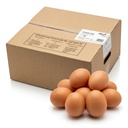
Fresh Swiss hen eggs from barn farming (Bodenhaltung), white shell, quality grade A and size M, 53-63 g per egg, supplied in a carton of 90. A professional-volume format for restaurants, pizzerias, pastry labs, bakeries and hotel kitchens that crack dozens of eggs every service.
What barn-farmed eggs are
Barn farming (Bodenhaltung) means the hens move freely inside a covered henhouse, with litter, perches and nesting areas, but without outdoor access. On the shell it is marked with farming code 2. It is the middle category between cage farming (code 3) and free-range or organic (codes 1 and 0): a practical balance between animal welfare and a stable, year-round supply at a fair cost, which is exactly what professional kitchens need to plan their production.
Swiss origin and grade A quality
These eggs are produced in Switzerland under Swiss food law. Grade A means class-A fresh eggs intended for direct consumption: they are not washed, the cuticle is intact, the air cell is small, the white is dense and the yolk sits compact and centred. Size M covers eggs of 53-63 g, the reference calibre of classic recipes: when a recipe simply says one egg, it means a size M egg.
The egg in professional cooking
The egg is the most versatile binding and structuring ingredient in the kitchen. Whipped whole or separated, it builds volume in sponge cakes, savoiardi and meringues; the yolk emulsifies mayonnaise, hollandaise and zabaglione; the whole egg binds fresh pasta dough, batters, meatballs and breading; and it sets custards, flans, frittatas and spoon desserts such as tiramisu and creme caramel.
Professional uses and doses
- Fresh egg pasta: about 1 egg per 100 g of flour for tagliatelle, lasagne sheets and ravioli.
- Portion frittata or omelette: 2-3 eggs per person, cooked over medium heat.
- Sponge cake: 4 eggs per 120 g flour and 120 g sugar for a light, airy crumb.
- Zabaglione and custards: use the yolks with sugar and wine or milk, cooked gently below boiling point.
- Breading and binding: beaten whole egg as the middle step between flour and breadcrumbs for cutlets, croquettes and arancini.
Common mistakes to avoid
- Adding cold eggs straight from the fridge to a batter that needs volume: bring them to room temperature first.
- Boiling custards and zabaglione: keep them under the boil or the egg curdles.
- Storing eggs near strong-smelling foods: the porous shell absorbs odours.
Storage and shelf life
Keep refrigerated at 2-4 degrees C, away from strong odours, with the pointed end down. Class-A fresh eggs are best used within the best-before date printed on the shell or pack. After that date, consume only thoroughly cooked. Do not freeze eggs in the shell.
Delivery and logistics
B2B and B2C refrigerated delivery throughout Switzerland from the LAPA warehouse in Embrach (Zurich). Cold chain at 2-4 degrees C guaranteed by the LAPA fleet across Zurich, Winterthur, Uster, Aargau, St. Gallen, Lucerne, Zug and Bern. For Ticino (Lugano, Bellinzona, Locarno), French-speaking Switzerland (Geneva, Lausanne, Vevey, Sion), Valais and mountain regions (Davos, St. Moritz, Chur) delivery within 24-48 hours via certified food-grade couriers (Swiss Post Frigo-Express, Planzer, Galliker, Camion Transport). Service tailored for restaurants, pizzerias, pastry labs, gelato shops, hotels, delicatessens, Italian grocery stores and private customers.
Who it is for
Designed for high-turnover professional kitchens that need a reliable, consistent supply of fresh Swiss eggs in a large 90-piece format, plus private customers who cook and bake at home and want true class-A quality.