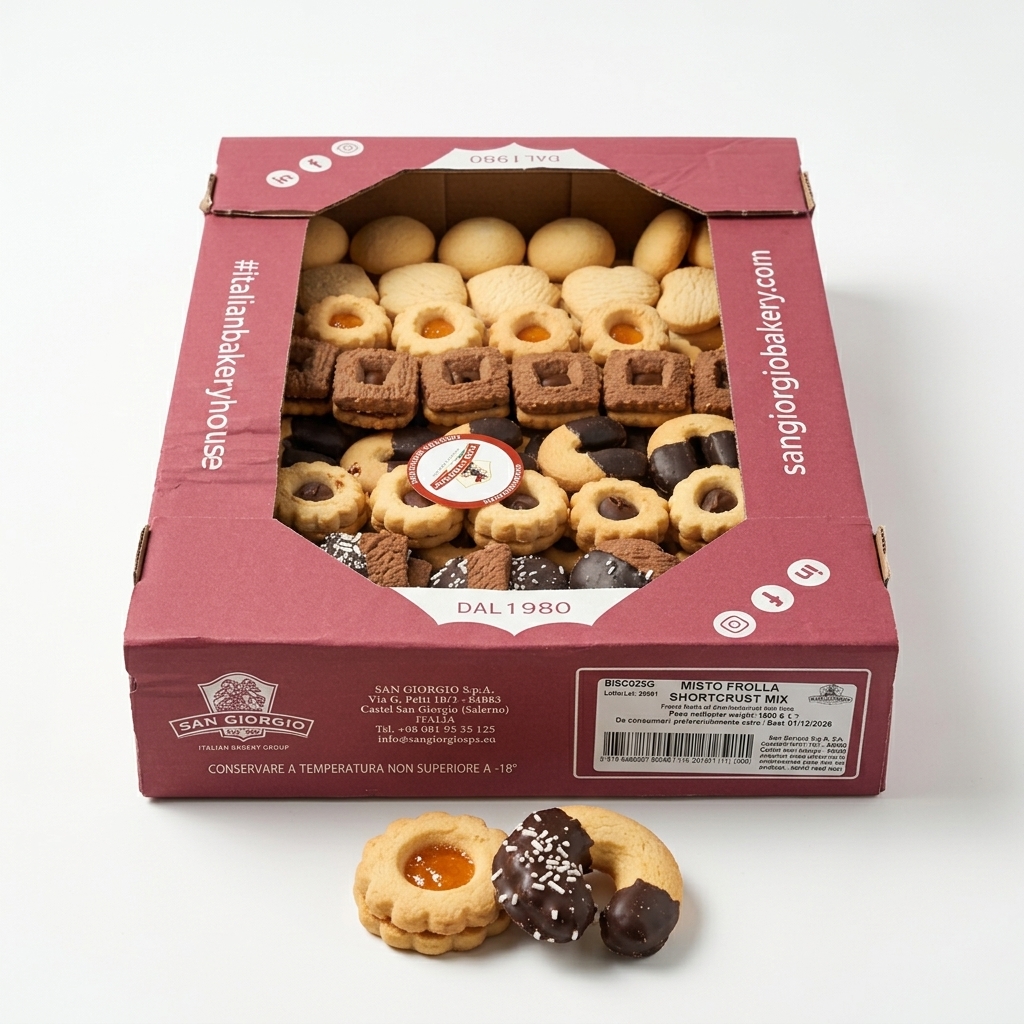
Assorted Shortcrust Biscuits, Frozen — 1.5 kg Carton
Assorted shortcrust biscuits supplied frozen in a 1.5 kg carton, ready to be brought to temperature and served. They are the classic Italian pasticceria secca mix: butter-style shortcrust in several shapes and finishes, some plain, some filled with jam or coated in chocolate. The format is built for hotel breakfast buffets, bar counters, coffee breaks and catering, where a mixed biscuit basket has to look full without a pastry chef assembling it every morning. Frozen storage means you open only what the day requires and the rest keeps at minus 18 degrees Celsius. LAPA delivers it under controlled temperature across Switzerland.
What Shortcrust Pastry Is
Shortcrust, pasta frolla in Italian, is one of the founding doughs of European pastry: flour, fat, sugar and eggs worked briefly so the fat coats the flour rather than developing gluten. That is the whole point of the technique, and it is where the name comes from: short means crumbly, not elastic. A correct frolla breaks cleanly, melts on the palate and carries flavour without chewiness. Assorted biscuits built on this dough have been the standard offering of Italian pastry shops for generations, sold by weight and served with coffee, tea, dessert wine and breakfast.
Why Frozen Makes Commercial Sense
Frozen bakery solves the two structural problems of biscuit service: waste and labour. A shelf-stable biscuit tin has to be consumed before it goes stale once opened, which pushes operators to over-serve or to throw away. A frozen carton is drawn down in portions: you take out what the shift needs, the rest stays intact at minus 18 degrees Celsius. There is no proofing, no baking, no pastry section required, and the product reaching the guest is consistent every single day, whatever the staffing situation that morning.
Service and Handling
Take out only the quantity needed for the service and let it come to room temperature on a tray, uncovered, for roughly 15 to 30 minutes depending on size and room conditions. Do not refreeze what has been thawed. Once at temperature, keep the biscuits in a closed container or under a dome: humidity is the enemy of shortcrust and turns a crisp biscuit soft within hours. For a breakfast buffet, replenish in small batches through the service rather than filling one large basket at opening.
Professional Uses
Five uses cover the format. First, the hotel breakfast buffet, where a mixed basket sits alongside croissants and yoghurt. Second, the bar counter, biscuits served with espresso or cappuccino as a small paid add-on or as a courtesy. Third, coffee breaks and seminar catering, where a mixed plate per table is faster to set than individual desserts. Fourth, the dessert plate: two or three biscuits with a dessert wine, an affogato or a scoop of gelato. Fifth, room service and welcome amenities in hotels, where a small individually plated selection adds perceived value at very low cost.
Portioning and Yield
Working figures for planning: about 20 to 30 grams per person as a coffee-break accompaniment, 40 to 60 grams per cover on a breakfast buffet where biscuits are one option among several. On that basis a 1.5 kg carton covers roughly 25 to 40 breakfast covers or 50 to 70 coffee breaks. These are planning reference points, not a specification: actual consumption depends heavily on what else is on the buffet.
Common Mistakes to Avoid
Three habits ruin the product. Thawing the whole carton at once, then refreezing the surplus, destroys texture and is a food-safety problem. Leaving thawed biscuits exposed on the buffet all morning lets them absorb humidity until they bend instead of snapping. Storing the carton in the door of the freezer or in a unit that swings above minus 18 degrees Celsius causes fat migration and a dull, greasy surface.
Distribution and Logistics in Switzerland
LAPA operates from Embrach in the canton of Zurich with its own frozen and refrigerated fleet, holding the cold chain at minus 18 degrees Celsius from the warehouse to the delivery point, and serves Zurich, Winterthur, Basel, Bern, Lucerne, St. Gallen, Zug, Aarau, Schaffhausen, Chur and Lugano. Areas outside the direct rounds are covered through Swiss Post, Planzer, Galliker and Camion Transport. Customers include hotels, bars, cafeterias, pastry shops, catering companies, canteens and Italian food retailers, as well as private customers ordering online.
Who It Is For
This carton is for operations that serve biscuits every day without running a pastry section: hotels with breakfast service, bars and cafeterias, seminar and conference venues, catering companies, retirement homes and canteens. Pastry shops producing their own frolla will use it as a backup for peak days rather than as a core line.