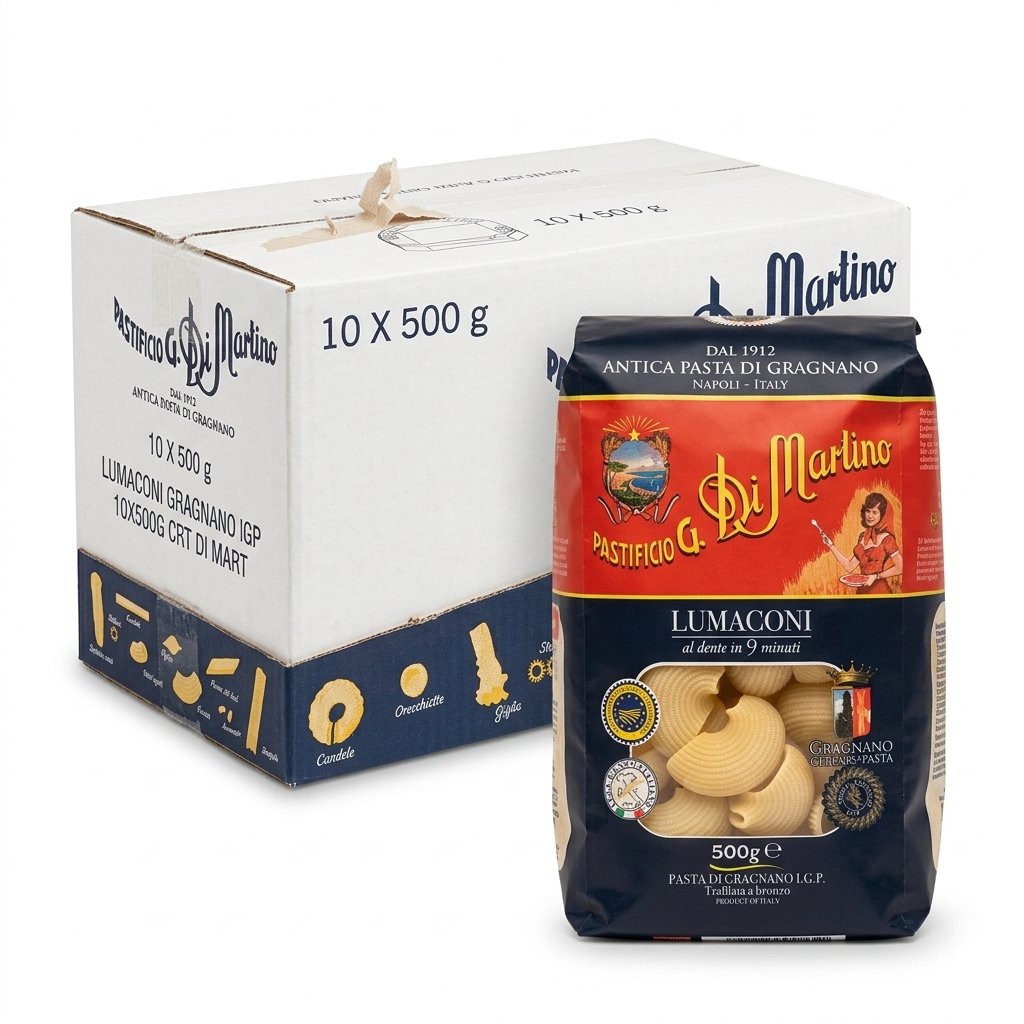
Lumaconi di Gragnano IGP by Pastificio Di Martino are a large ridged shell shape in pure durum wheat semolina, bronze-drawn and slow-dried, designed to be stuffed and baked. The wide cavity holds rich fillings such as ricotta and spinach or Neapolitan meat ragù, while the porous bronze-drawn surface clings to every sauce. Cooked al dente in 9 minutes, with 354 kcal and 14 g of protein per 100 g, certified Pasta di Gragnano IGP, produced in Gragnano (Naples) since 1912.
What Lumaconi are
Lumaconi (literally large snails) are one of the most generous short shapes in the Neapolitan tradition: a wide, curved shell with deep ridges and an open cavity. They belong to the family of stuffable formats, alongside conchiglioni and bombardoni, and are conceived for fillings and oven gratins rather than light dressings. In Gragnano, the city of pasta at the foot of the Lattari Mountains, this shape has been part of the artisan repertoire for centuries.
Geographic origin
Pasta di Gragnano has been documented since the 16th century in the Campanian town of Gragnano, in the province of Naples. The combination of wind from the sea, sun and humidity created the ideal natural microclimate for slow drying. By 1861 Gragnano already dominated global pasta exports, and on 12 July 1845 King Ferdinand II granted local producers the privilege of supplying the royal court, earning the town the title of city of maccheroni.
The producer
Pastificio Di Martino was founded in 1912 by Giuseppe Di Martino in Gragnano, in Via Castellammare. In 1915 its pasta crossed the Panama Canal for the first time, opening the way to global export. Di Martino was a driving force in the recognition of Pasta di Gragnano IGP, obtained in October 2013, and is today a Società Benefit committed to the territory and to durum wheat supply chains.
Organoleptic characteristics
The bronze die gives the shell a rough, matte, porous surface, the visible signature of artisan pasta. Slow drying at low temperature, up to around 60 hours, preserves the protein structure and the fragrant aroma of durum wheat. After cooking the pasta stays firm and toothsome, with a wheat-forward flavour and a colour that ranges from straw to amber.
Technical specifications
Ingredients: durum wheat semolina and water. Contains gluten. Average nutritional values per 100 g: energy 1502 kJ / 354 kcal, fat 1.3 g (of which saturates 0.3 g), carbohydrate 70.0 g (of which sugars 3.3 g), fibre 3.3 g, protein 14.0 g, salt below 0.01 g. Net weight 500 g per pack, case of 10 packs. Cooking time approx. 9 minutes for al dente.
Uses in professional kitchens
Stuffed and baked: fill each shell with ricotta and spinach, season with tomato and gratin with Parmigiano Reggiano. Meat ragù: stuff with Neapolitan ragù (Genovese or ragu napoletano) and bake. Seafood version: ricotta and prawns, finished with a scampi cream. Vegetarian: aubergine, smoked provola and basil. Classic bake: dress with San Marzano tomato and bake at 180 degrees for 15 minutes until golden. Dose: 80-100 g per portion as a first course, 60-70 g if part of a tasting menu.
Pairings
Lumaconi pair naturally with creamy fillings and structured sauces: ricotta and spinach, Neapolitan ragù, San Marzano tomato, Parmigiano Reggiano and Grana Padano, basil and extra virgin olive oil. For a seafood twist, combine with a scampi cream and a hint of fresh chilli. Avoid very fluid dressings that would slide off the large cavity.
Delivery and logistics
B2B and B2C delivery throughout Switzerland from the LAPA warehouse in Embrach (Zurich). As a dry ambient product, Lumaconi require no cold chain and ship on full pallets or as standard parcels across Zurich, Winterthur, Uster, Aargau, St. Gallen, Lucerne and Bern. For Ticino (Lugano, Bellinzona, Locarno), French-speaking Switzerland (Geneva, Lausanne, Vevey), Valais (Sion, Martigny) and mountain regions (Davos, Chur) shipment within 24-48 hours via partner couriers such as Swiss Post PostPac, Planzer and Galliker. Ideal for stocking up professional pantries.
Who it is for
Lumaconi di Gragnano IGP Di Martino are aimed at restaurants, pizzerias, trattorias, hotels, delicatessens, catering kitchens and Italian grocery stores, as well as private customers who cook authentic Italian cuisine at home. A reliable IGP short shape for menus that feature baked and stuffed pasta.