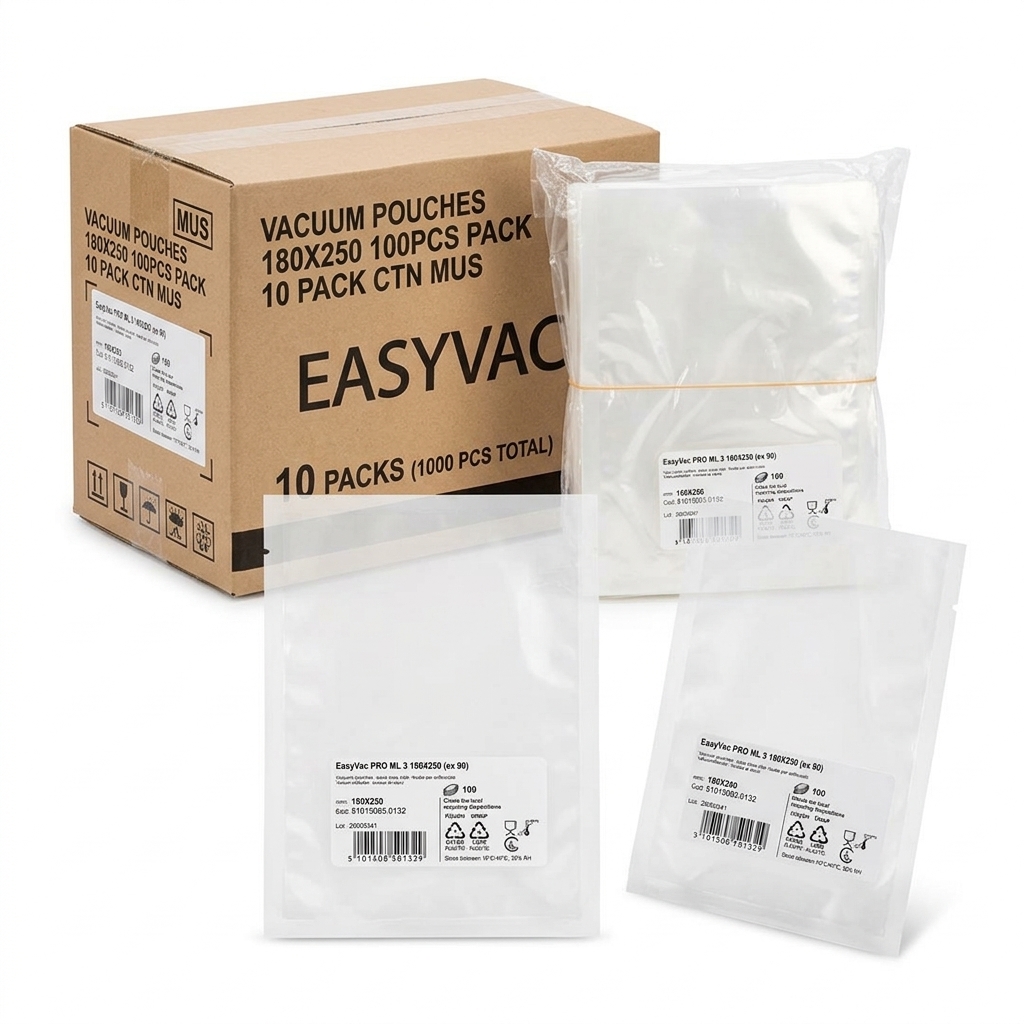
Vacuum Sealer Bags for Food 180x250 mm — Pack of 100
Vacuum bags in the 180 by 250 mm format, supplied in packs of 100. This is the single-portion and small-batch size of a professional kitchen: a chicken breast, a fillet, a fish steak, 200 to 500 g of cheese or cured meat, a portioned sauce, the daily mise en place. Vacuum packing removes the oxygen that drives oxidation and aerobic spoilage, which typically extends refrigerated shelf life several times over and is one of the simplest ways to cut waste in a kitchen that prepares ahead. LAPA supplies them alongside the food order, delivered across Switzerland.
Why Kitchens Vacuum Pack
Five uses cover most of the work. Storage: sealed portions keep in the fridge far longer than covered containers and stack cleanly, which matters when fridge space is the real constraint. Rapid marination: the pressure differential opens the structure of the product and drives salt and aromatics in within minutes rather than hours. Portioning: pre-weighed sealed portions make service faster and food cost measurable. Freezing: vacuum packing before the blast chiller prevents freezer burn and surface ice crystals. And sous-vide cooking, provided the bag is explicitly declared suitable for cooking, which is the point covered below.
A Short History of Sous-Vide
The technique was patented industrially in the 1960s for preservation. It entered high-end cooking in 1974, when Georges Pralus, working at Troisgros in Roanne, cooked foie gras under vacuum and found it lost neither fat nor shape. Bruno Goussault then codified times and temperatures scientifically and became the trainer of a generation of chefs. In Spain, Joan Roca of El Celler de Can Roca developed the Roner immersion circulator with Narcis Caner, the name formed from their two surnames. From the early 2000s the method spread from three-star kitchens to ordinary restaurant practice.
Choosing the Right Format
The rule is simple: the bag should be roughly 4 to 5 cm longer and wider than the product. That leaves a clean sealing margin and lets the film wrap the item without tension on the corners, which is where bags fail. At 180 by 250 mm this format covers the single portion and the small batch. Larger cuts, whole loins and bulk batches need a bigger size; using an undersized bag and forcing the product in is the most common cause of a seal that opens two days later in the fridge.
Smooth or Embossed: It Depends on the Machine
This is a machine question, not a food question. Chamber machines, the standard professional equipment, work with smooth bags: the chamber evacuates air from around the whole bag. External suction machines need embossed bags, whose micro-textured surface creates the channels the air escapes through; a smooth bag in an external machine simply will not evacuate. Before ordering in volume, check which type your machine takes.
Food Contact Compliance
Materials in contact with food are governed by Regulation (EC) 1935/2004 and, for plastics, Regulation (EU) 10/2011, with migration testing across all simulants; Switzerland applies the equivalent federal ordinance on materials and articles in contact with foodstuffs. In practice this means every batch should be covered by a declaration of conformity from the supplier, and that document belongs in your HACCP file. Vacuum packing is itself a control point: material suitability, seal integrity, and traceability of date and batch written on the bag.
Common Mistakes to Avoid
Three habits cause most failures. Sealing over a dirty or wet edge: fat, crumbs or sauce drawn up to the sealing bar prevent a uniform weld, and the vacuum is lost hours later. Dry the edge, or freeze liquids first, and keep the sealing bar clean. Reusing bags: like vacuum trays they are single-use, and reuse means cross-contamination, unremovable fat residue and invisible micro-tears in the barrier. Using storage-grade bags for cooking: a bag rated only for preservation can delaminate in a water bath or in prolonged pasteurisation. Check the manufacturer's declaration rather than assuming thickness alone tells you what a bag can take.
Distribution and Logistics in Switzerland
LAPA operates from Embrach in the canton of Zurich with its own fleet, serving Zurich, Winterthur, Basel, Bern, Lucerne, St. Gallen, Zug, Aarau, Schaffhausen, Chur and Lugano. Areas outside the direct rounds are covered through Swiss Post, Planzer, Galliker and Camion Transport. Non-food items like vacuum bags travel with the food order at no additional transport cost: one delivery, one supplier, one invoice. Customers include restaurants, pizzerias, hotels, gastronomies, butchers, processing laboratories and independent retailers.
Who It Is For
This format is for kitchens that portion and prepare ahead: restaurants with a mise en place discipline, catering companies, delicatessen and butchery counters, and hotel kitchens managing banqueting. Sites vacuum packing whole cuts or bulk batches should order the larger sizes; those working with an external suction machine should confirm they need the embossed version before ordering.
Product Specifications
- Type: Vacuum sealer bags for food
- Dimensions: 180 x 250 mm
- Content: Pack of 100 bags
- Typical use: Single portions and small batches: 200 to 500 g of product
- Usage: Refrigerated storage, marination, portioning, freezing; sous-vide cooking only where the supplier declaration confirms suitability
- Regulatory framework: Materials in contact with food, Regulation (EC) 1935/2004 and Regulation (EU) 10/2011, with the equivalent Swiss federal ordinance
- Application sectors: Restaurants, hotels, catering, delicatessens, butchers, processing laboratories
- EAN code: 5101508501329
- HS customs code: 3923.21
- Note: Film thickness, smooth or embossed type and maximum use temperature are stated in the supplier technical sheet; ask us for the declaration of conformity for your HACCP file
Specifications
| Categoria Pizza | Packaging asporto |
Alternative Products
These other products might interest you