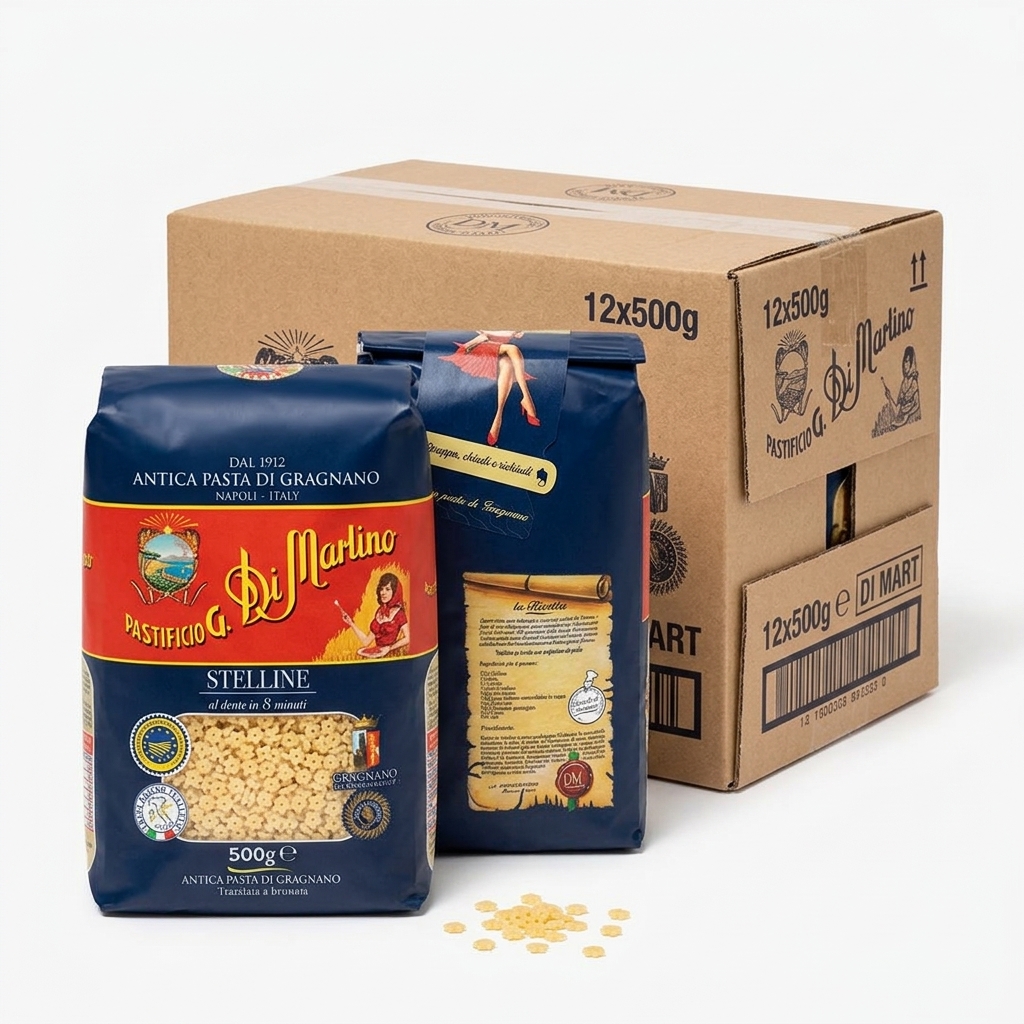
Stelline di Gragnano IGP by Pastificio Di Martino are dried soup pasta in pure durum wheat semolina, bronze-drawn and slowly dried, packed in 500 g bags (case of 12). A small "pastina" format protected by the Pasta di Gragnano PGI, ideal for broths, soups and veloutes, cooking in about 8 minutes with excellent hold.
What Stelline are
Stelline ("little stars") belong to the family of "pasta minuta", the small formats traditionally cooked directly in hot liquid. Their star shape makes them a classic of broths and minestrone, much loved in children's menus. Made only from durum wheat semolina and water, they keep a firm bite and a clean wheat flavour.
Pasta di Gragnano PGI: origin and history
Large-scale pasta making around Naples dates back at least to the 16th century, when Gragnano was found to have the ideal microclimate, with steady ventilation and humidity, to dry the dough in the open air. In 1833 Ferdinand II of Bourbon inaugurated the first industrial pasta factory in Campania. Today Pasta di Gragnano is protected by the PGI mark, which certifies compliance with a strict local production specification.
Bronze drawing and slow drying
Extrusion takes place exclusively through bronze dies, which give the pasta a characteristic porosity, roughness and opacity, the property that lets it grip broths and sauces tenaciously. Slow drying at moderate temperature over many hours consolidates the natural gluten network of the semolina, ensuring elasticity and resistance during cooking.
Professional uses
- Light soup pasta in reduced chicken, beef or vegetable broth for traditional menus and banqueting.
- Risotto-style legume soups: cook the stelline directly in the bean, pea or lentil soup so the starch binds it into a dense, creamy texture.
- Gratin pastina for gourmet kids' menus: cooked very al dente in broth, bound with bechamel and Grana Padano DOP, then briefly baked.
- Cold pastina salads for summer buffets, dressed raw with cherry tomatoes, fior di latte and basil.
- Light and clinical menus: thanks to easy digestibility, stelline in light vegetable broth suit hospital, clinical and school catering.
Common mistakes to avoid
Always add the pastina only when the water or broth has reached a full boil: starting in cold or lukewarm liquid dissolves the surface starch and makes the soup gluey. For dry or risotto-style preparations, do not rinse away all the starch, which provides the creamy emulsion. Always salt the cooking water, since salt strengthens the gluten network of the semolina.
Recommended portion
For soup pasta in broth, 40 g of dry stelline per serving with about 150-200 ml of boiling broth; for thick vegetable soups, 50-60 g per person.
Chef references
Campanian gastronomy is championed by chefs such as Gennaro Esposito (Torre del Saracino) and Niko Romito (Reale), known for an essential approach that valorises the purity of agricultural ingredients, as in his pasta cooked in vegetable broth alone.
Logistics and delivery
LAPA delivers Pasta di Gragnano and dry specialities throughout Switzerland from its central warehouse in Embrach (Zurich). As a dry, ambient product, pasta needs no refrigerated cold chain, making it ideal for fast shipping and stock optimisation. Direct delivery with the LAPA fleet covers Zurich, Winterthur, Uster, Dubendorf, St. Gallen, Frauenfeld, Bern and Basel; for Ticino (Lugano, Mendrisio, Chiasso), French-speaking Switzerland (Geneva, Lausanne, Fribourg, Sion, Martigny) and Graubunden (Chur, Davos, St. Moritz), shipping is guaranteed within 24-48 hours through food-grade partner couriers: Swiss Post, Planzer, Galliker and Camion Transport. We serve Italian restaurants, pizzerias, hotels, delicatessens, pastry shops, gelaterias and private customers.
Who it is for
A professional choice for restaurants, canteens, hotels and caterers who want authentic PGI Italian pasta for broths and soups, with the consistency and traceability that the food-service channel requires.