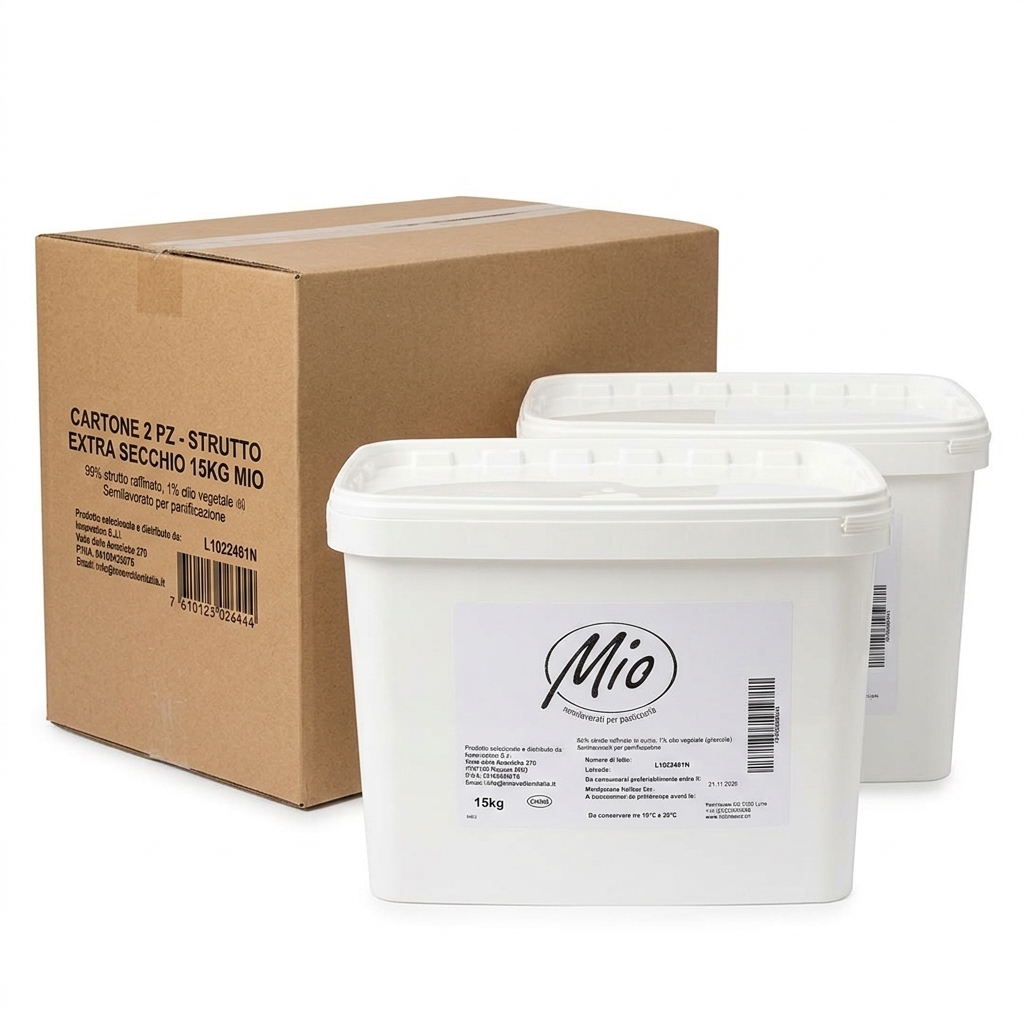
Extra Lard MIO: pure pork fat for professional baking and pastry
Extra Lard MIO is a refined pork fat for bakeries, pizzerias and professional kitchens, supplied in a practical 15 kg bucket (carton of 2 buckets, 30 kg total). Composition: 99% refined pork lard, 1% sunflower oil. Stable at room temperature, it gives unmatched flakiness to short pastry, softness to leavened doughs and authentic flavour to traditional Italian recipes. Distributed by INNOVACTION S.R.L. (Ragusa, Sicily).
What lard is and its history
Lard (in Italian strutto or sugna) is the animal fat obtained by melting and pressing the adipose tissue of the pig. Historically it was a cornerstone of Italian baking and rotisserie, used as an economical alternative to the costly olive oil. In the rural Centre-North (Marche, Emilia) its production was tied to the winter pig slaughter between November and January, when the grasselli, the residue of the rendered lard, were also collected. Lard became the popular everyday condiment par excellence because it was cheap and could be bought in tiny portions.
Professional uses in the kitchen
Lard is a structural and aromatic noble fat. Main professional uses documented in the Italian tradition:
- In great traditional leavened breads (Neapolitan Casatiello and Tortano) worked directly into the bread dough for softness, elasticity and a soft interior crumb.
- As a historic topping for Neapolitan pizza: spread on the disc base, dusted with grated cheese and basil before fast cooking at very high temperature (430 to 485 degrees C), as in the antique Mastunicola pizza.
- In the dough of traditional taralli sugna, pepe e mandorle, the Campanian baked rings, for crumbliness and flavour.
- For regional soffritti and frying (Lombard and Southern tradition), where lard was the fat of choice when olive oil was a rarity.
- In the Marche pizza coi grasselli, enriching the leavened dough with the cracklings left from rendering the lard.
Common mistakes to avoid
- Do not replace lard with hydrogenated sweet vegetable creams in savoury doughs or soffritti: it irreparably alters the flavour with a cloying sweet note.
- Do not omit lard from the menu: it is a 100% animal fat, unsuitable for vegetarian customers, and its presence must be declared under EU Reg. 1169/2011.
- Do not store the buckets near ovens or direct heat: it accelerates thermal oxidation of the lipids and makes the fat rancid.
Storage and packaging
Lard is a solid fat that is stable at room temperature and needs no cold chain. Store between 15 and 22 degrees C, in a dry place with relative humidity below 60%, away from direct heat sources and sunlight to prevent lipid oxidation and rancidity. Each carton contains 2 buckets of 15 kg, for 30 kg total, ideal for stocking professional workshops.
Distribution and logistics LAPA
B2B and B2C supply of lard, flours and Italian ambient specialities is handled across Switzerland from the LAPA central warehouse in Embrach (Zurich). Direct deliveries with the LAPA fleet cover Zurich, Winterthur, Uster, Dubendorf, St. Gallen, Frauenfeld, Bern, Basel and the Aargau canton (Aarau, Wettingen, Baden). For Ticino (Lugano, Mendrisio, Chiasso), French-speaking Switzerland (Geneva, Lausanne, Fribourg), Valais (Sion, Martigny) and Grisons (Chur, Davos, St. Moritz), standard ambient shipping arrives within 24 to 48 hours via our food-grade partner couriers: Swiss Post, Planzer, Galliker and Camion Transport AG. As a non-perishable product, lard requires no refrigerated chain and is ideal for full pallets and stock replenishment. We serve restaurants, pizzerias, hotels, gastronomies, pastry shops, bars and Italian grocery stores throughout Switzerland.
Who it is for
For pizzerias, bakeries, pastry laboratories, gastronomies and professional kitchens that want an authentic pork fat for traditional Italian baking and pastry, in a practical and economical 15 kg format.
Product Specifications
- Legal name: Refined pork lard
- Brand: MIO
- Distributor: INNOVACTION S.R.L., Ragusa (RG), Sicily, Italy
- Composition: 99% refined pork lard, 1% vegetable oil (sunflower)
- Usage: Semi-finished fat for baking and pastry
- Content: 15 kg bucket
- Packaging: Carton of 2 buckets (30 kg total)
- Storage: At room temperature between 15 and 22 degrees C, humidity below 60%, away from heat and light
- Certifications: CH305
- EAN code: 7610286026644
- HS customs code: 1501.10
- Country of origin: Italy
Specifications
| Brand | Mio |
Alternative Products
These other products might interest you