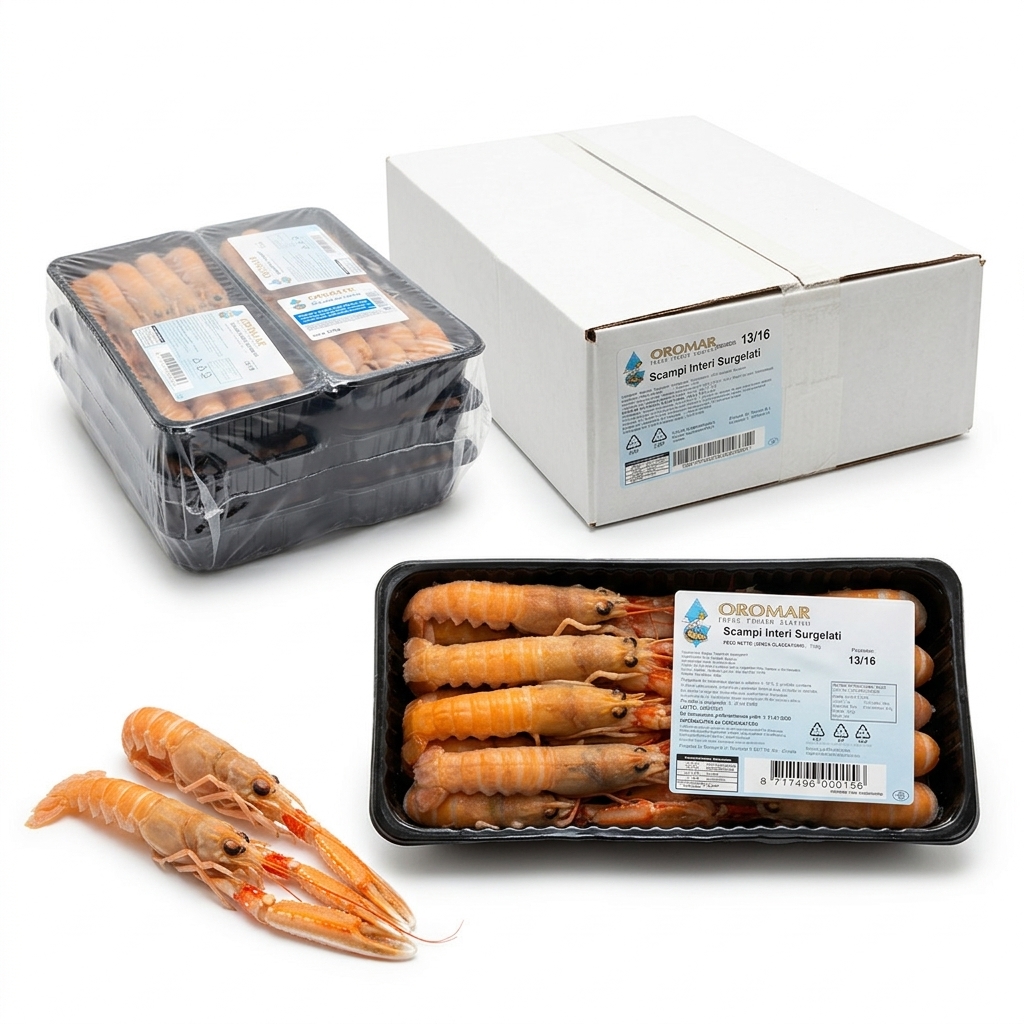
Whole frozen langoustines (Nephrops norvegicus) in the 13/16 pieces-per-kg size, Oro quality, supplied in a case of 6 packs of 750 g for a net weight of 4.5 kg without glaze. Caught in the Northeast Atlantic (FAO 27, North Sea, ICES IVa,b,c) with bottom trawls and frozen shortly after catch, they keep a firm, sweet flesh ideal for raw preparations, grilling, frying and seafood pasta in professional kitchens.
What are langoustines (scampi)
The langoustine, known in Italian as scampo and scientifically as Nephrops norvegicus, is a slender clawed crustacean of the Norway lobster family, not to be confused with prawns or with the warm-water Argentine red shrimp. Its prized, delicately sweet tail meat and the flavour locked in its head and claws make it one of the most sought-after raw materials of European seafood cuisine. It is fished mainly in the cold waters of the Northeast Atlantic and the North Sea, where slow growth gives the flesh its characteristic firmness.
Size and yield
The 13/16 grade means 13 to 16 whole langoustines per kilogram, that is large, regular specimens with excellent plate presence. This calibre is the reference size for fine dining: each piece is generous enough to be served whole, grilled or raw, while remaining uniform for consistent cooking and portioning. The declared net weight of 4.5 kg refers to the product without the protective ice glaze, so the kitchen can plan yield reliably.
Origin and fishing
These langoustines are landed in the Northeast Atlantic, FAO zone 27, North Sea (ICES divisions IVa, b and c), using bottom otter trawls (gear code OTB). The catch is processed and frozen in the Netherlands. Freezing on or shortly after landing preserves the natural texture and the sweet marine aroma, delivering a constant quality that fresh langoustines, highly seasonal and perishable, cannot guarantee year round.
Organoleptic profile
Raw, the tail meat is translucent, firm and glossy, with a clean, delicately sweet scent of the sea. Cooked, it turns opaque white with coral-pink shell tones and develops a tender, succulent bite. The heads and shells release an intense, sweet stock prized for bisques and risottos. Sulphites (antioxidant E223) are added to protect colour and prevent melanosis (the natural blackening of the shell).
Professional uses
Whole langoustines of this size are extremely versatile in the professional kitchen. Serve them raw as crudo or carpaccio with citrus and quality olive oil; split lengthwise and grill or oven-roast with garlic butter; pan-sear the tails for risotti and seafood pasta; deep-fry in a light batter as part of a fritto misto; or simmer the heads and shells to build a deep bisque. The generous 13/16 calibre also makes them a striking centrepiece for seafood platters.
Storage and handling
Store at minus 18 degrees Celsius or below until use. Thaw slowly under refrigeration. Once thawed, the product must not be refrozen: keep it refrigerated and use it within 24 hours, cooking before consumption. Careful cold-chain management preserves both food safety and the delicate texture of the meat.
Delivery and logistics in Switzerland
LAPA distributes frozen seafood across Switzerland with its own refrigerated fleet to Zurich, Basel, Bern, Lucerne, St. Gallen, Winterthur and Lugano, and through partner couriers (Swiss Post, Planzer, Galliker, Camion Transport) for areas not covered directly. Clients include restaurants, pizzerias, hotels, fine-dining kitchens, fishmongers and Italian delicatessens, as well as private customers looking for restaurant-grade seafood.
Who it is for
This product is designed for professional kitchens that need a reliable, year-round supply of premium whole langoustines: seafood restaurants, fine-dining venues, hotels and catering operations that value a large, regular calibre and the consistency only frozen-at-source product can offer.