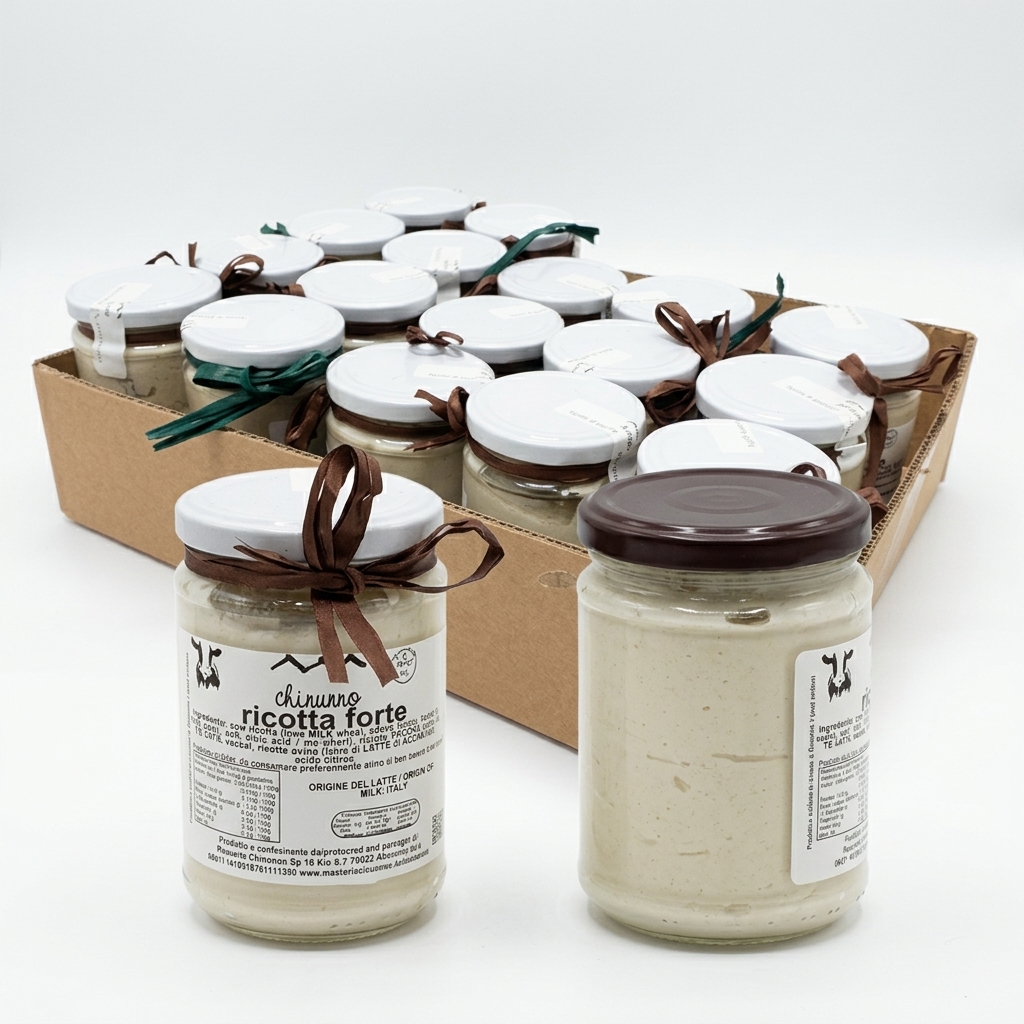
Ricotta Forte Pugliese: the fermented soul of Apulia
Ricotta Forte Mista Pugliese by Masseria Chinunno is a fermented, spreadable ricotta made from cow and sheep whey ricotta, salt and citric acid, in a 320 g unit. Aged for two to four months according to Apulian tradition, it develops an intense, tangy and slightly piquant flavour that seasons an entire dish with just one teaspoon. It is the classic condiment for orecchiette with tomato sauce and the traditional filling of fried panzerotti.
What is ricotta forte
Ricotta forte, also known in Apulia as ricotta scanta, is one of the oldest examples of dairy fermentation in Southern Italy: fresh ricotta is worked and left to ferment for two to four months, traditionally in terracotta vessels, until it turns into a soft, ivory-coloured cream with a deep, pungent aroma. Born as a way to preserve ricotta beyond its short life, it became a signature flavour of the Apulian kitchen, used in tiny doses like a seasoning rather than eaten as a fresh cheese.
The producer: Masseria Chinunno, Altamura
Masseria Chinunno is a family farm founded in 1954 by Vito and Marietta in the countryside of Altamura (Bari), inside the Alta Murgia National Park near the Mercadante Forest. Today the estate covers 177 hectares and combines livestock farming with traditional dairy production. The ricotta forte is made on the farm following the traditional fermentation method, from the whey of the farm's own milk processing.
Sensory profile
Soft, creamy and easily spreadable texture; the flavour is savoury, sharp and slightly spicy, with the characteristic pungent note of long fermentation. The blend of cow and sheep whey ricotta gives a rounder body than pure sheep versions, while keeping the typical intensity that defines the product. Per 100 g it provides 279 kcal, 21 g of fat, 16 g of protein and 2.5 g of salt.
Professional uses in the kitchen
One teaspoon melted in the tomato sauce just before tossing is the canonical dose for a portion of orecchiette or cavatelli al pomodoro. In the fryer station it is the traditional filling of Apulian panzerotti, alone or with tomato. On the bread course it works spread on warm bruschetta with anchovy fillets, or in small dots on focaccia barese. In the cheese board it pairs with honey for a sweet-savoury contrast that softens its pungency.
Common mistakes to avoid
Do not dose it like fresh ricotta: it is a seasoning, and more than a teaspoon per portion can overwhelm the dish. Do not add it over high heat for a long time: melt it gently into the sauce off the boil to keep its aroma. Do not serve it as a table cheese to guests who expect a mild ricotta: announce it on the menu as ricotta forte.
Storage and shelf life
Store refrigerated at 0-4 °C. After opening, a thin layer of extra virgin olive oil on the surface protects the cream and extends its life. Thanks to fermentation and salt, ricotta forte is far more stable than fresh ricotta, but the cold chain must never be interrupted.
Distribution and logistics
Refrigerated B2B and B2C delivery in Switzerland from the LAPA warehouse in Embrach (Zurich). Cold chain at 2-4 °C guaranteed by the LAPA fleet across Zurich, Winterthur, Aargau, St. Gallen, Lucerne, Bern and Basel; for Ticino (Lugano, Bellinzona), French-speaking Switzerland (Geneva, Lausanne, Sion) and mountain regions (Chur, Davos) delivery within 24-48 hours via certified food-grade couriers such as Swiss Post Frigo-Express, Planzer and Galliker.
Who it is for
Designed for Apulian and Southern Italian restaurants, trattorias, pizzerias making panzerotti and calzoni, delicatessens, Italian grocery stores and private customers who want the authentic pungent taste of the Murgia on their table.