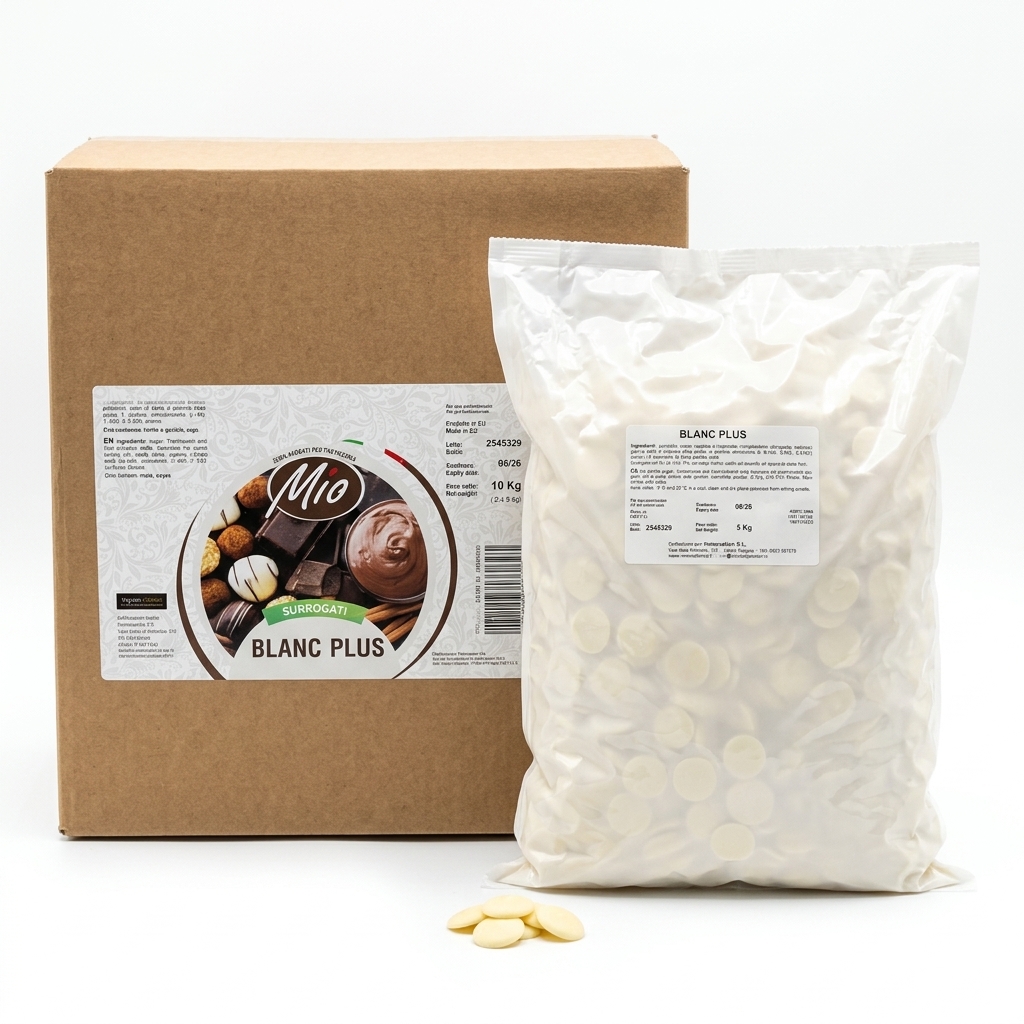
White chocolate flavoured compound coating in callets, supplied in a 10 kg case (2 x 5 kg vacuum-packed), Blanc Plus MIO brand. It is a pastry coating speciality based on vegetable fats instead of cocoa butter: it melts at about 40-45 °C and is worked without tempering, setting evenly and glossy at any cooling temperature. Ideal for high-volume professional kitchens that need working tolerance and food-cost control.
What is a white compound coating
A compound coating replaces the cocoa butter of real chocolate with fully hydrogenated vegetable fats. Legally and on menus it must be declared as a coating speciality or vegetable cream, never as chocolate, because only products containing cocoa butter may be called chocolate. The technical advantage is decisive: the vegetable fat solidifies uniformly at any cooling temperature, so no controlled crystallisation is required.
Why professionals choose the compound
Without tempering, even non-specialist operators obtain glossy coatings that do not bloom. The higher melting point keeps the product stable in non-refrigerated display cabinets, while the high fluidity speeds up dipping, enrobing and decoration in busy laboratories. It is the rational choice for controlling food cost on high volumes.
Professional uses
Glossy glazes and drip cakes; fast-setting lettering and graphic decorations piped onto acetate sheets; crunchy enrobing and dipping; stable ganache for fillings and coatings, emulsified hot with 35% cream at a 1:1 ratio; sweet spoon desserts and semifreddi emulsified with cream or mascarpone. The intense sweetness of the white compound is best balanced with sharp citrus notes, such as lemon zest in a white Caprese cake or passion fruit in a contemporary white-chocolate tiramisu.
Common mistakes to avoid
Do not overheat or over-whip the fat creams: prolonged mechanical action or uncontrolled melting temperatures break the emulsion and make the cream grainy. Do not declare the product as chocolate on menus or registers, which would be commercial fraud. Do not omit the primary allergens: milk and soy must always be highlighted under EU Regulation 1169/2011.
Storage
Keep at ambient temperature between 15 °C and 22 °C, relative humidity below 60%, in a cool, clean and dry place away from direct heat and sunlight and from strong odours. After opening, reseal the inner bag tightly or transfer the callets into an airtight container to protect them from kitchen humidity.
Logistics and delivery in Switzerland
Distribution starts from our central climate-controlled warehouse in Embrach (Zurich). As an ambient dry product it does not require refrigerated transport. We deliver with our own fleet in Zurich, Winterthur, Uster, Dubendorf, St. Gallen, Frauenfeld, Bern, Basel and across Aargau (Aarau, Wettingen, Baden). For Ticino (Lugano, Bellinzona, Locarno), Romandy (Geneva, Lausanne, Fribourg, Sion) and Grisons (Chur, Davos, St. Moritz) we ship in 24-48 hours through food-grade partner couriers: Swiss Post, Planzer, Galliker and Camion Transport.
Who it is for
For pastry shops, gelaterie, restaurants, hotels, bakeries, Italian delicatessens and food shops, as well as private B2C customers. More than 1,500 professionals in Switzerland source from LAPA.