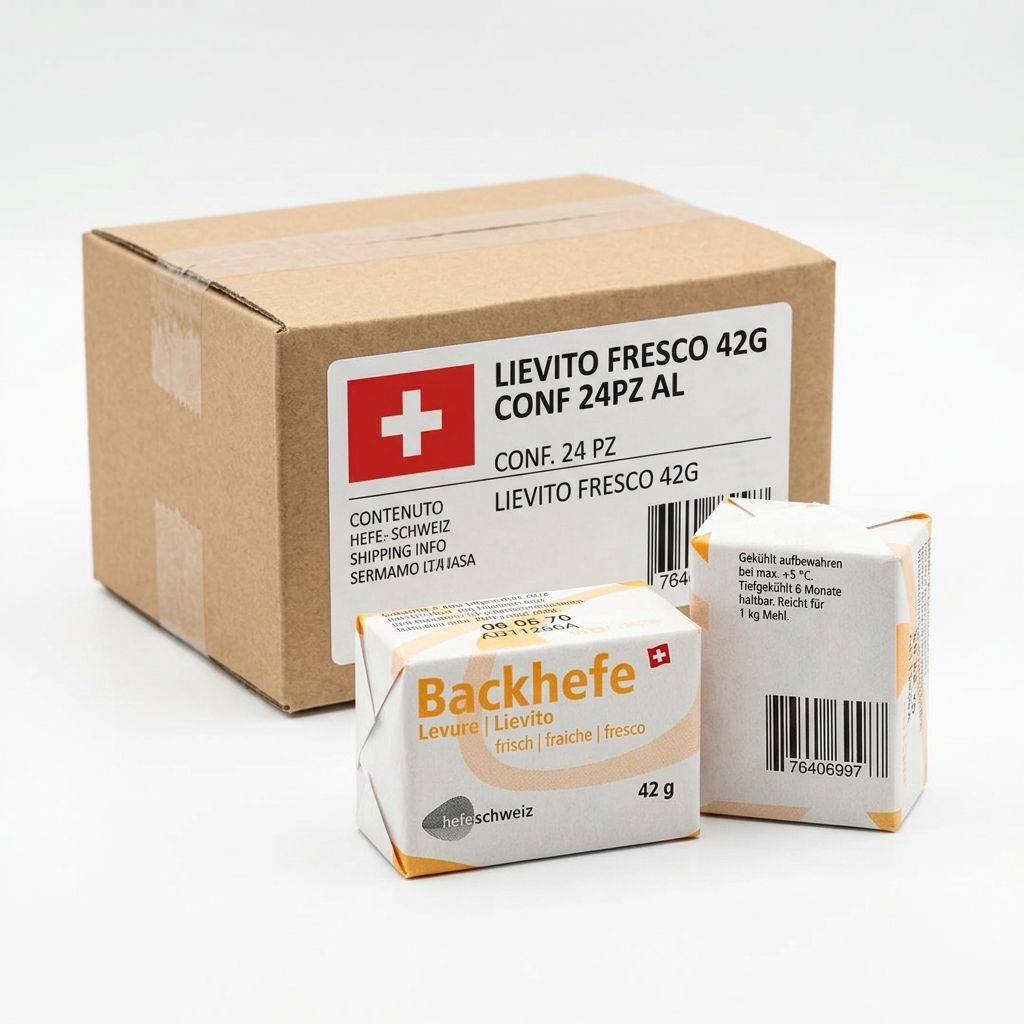
Fresh brewer's yeast (Saccharomyces cerevisiae) in a 42 g cube, supplied in a catering box of 24 cubes. A living leavening agent for pizza, bread, focaccia and pastry doughs, it delivers a strong, steady rise and a fragrant, well-developed crumb. Stored refrigerated at 0-5 degrees, it is the daily choice of professional pizzaioli and bakers who want full control over fermentation.
What Is Fresh Brewer's Yeast
Fresh brewer's yeast is a cake of living Saccharomyces cerevisiae cells pressed with a little water into a soft, crumbly cube. Unlike dry yeast, it is sold refrigerated and active straight away: the cells start to feed on the sugars in the flour as soon as the dough is mixed, producing the carbon dioxide that makes the dough rise and the alcohols and esters that build aroma. The 42 g format is the European standard cube, sized to leaven roughly 1 kg of flour in a direct same-day dough.
A Living Leavening Agent
Baker's yeast as we know it was isolated in the 19th century, but leavening bread with wild and brewer's yeasts is documented since ancient Egypt. In the Neapolitan tradition fresh yeast is the heart of the pizza dough: the AVPN protocol for true Neapolitan pizza calls for fresh brewer's yeast, sea salt, water and type 00 flour, with only 1 to 3 grams of yeast per kilo of flour for a slow, digestible fermentation.
How to Use It in a Professional Kitchen
- Neapolitan pizza dough: 1-3 g per kg of type 00 flour for an 8 to 24 hour fermentation; crumble it into the water before adding the flour.
- Direct same-day bread and focaccia: 15-25 g per kg of flour for a 2 to 4 hour rise at 22-24 degrees.
- Biga and poolish pre-ferments: about 1 g per kg of flour for an 18-hour biga, building dough strength and aroma.
- Brioche, panettone bases and enriched doughs: dissolve in warm milk at 35-38 degrees with a little sugar to kick-start activity.
- Cold fermentation in the fridge: reduce the yeast to 0,5-1 g per kg of flour for a 48 to 72 hour maturation at 4 degrees.
Dosage and Rising Times
As a rule, the longer the fermentation the less yeast you need. A 42 g cube leavens about 1 kg of flour in a fast direct dough, or up to 10-15 kg of flour over a long, cold 24 to 72 hour maturation. Always dissolve the yeast in liquid no warmer than 38 degrees: above 50-55 degrees the cells die and the dough will not rise.
Storage and Cold Chain
Fresh yeast is a living, perishable product. Keep it refrigerated at 0-5 degrees at all times and use it within the best-before date printed on the cube. A healthy cube is pale cream in colour, firm but crumbly, with a clean alcoholic smell; discard it if it turns brown, slimy or develops an off odour. Fresh yeast can be frozen for short periods, but freezing weakens part of the cells, so increase the dose slightly after thawing.
Common Mistakes to Avoid
- Adding the yeast directly onto the salt: salt dehydrates the cells and slows the rise. Dissolve the yeast in the water first and add the salt last.
- Using water hotter than 40 degrees: heat kills the yeast and gives a dense, flat dough.
- Overdosing to speed things up: too much yeast leaves a yeasty, alcoholic taste and a dough that collapses.
- Leaving the cube out of the fridge: above 8 degrees the yeast loses strength within hours.
Who It Is For
This 42 g cube in a 24-piece box is built for professional kitchens that work fresh dough every day: Neapolitan and Roman pizzerias, bakeries, focaccia and pinsa labs, pastry shops, hotels and gastronomy. It is equally suited to skilled home bakers who want the same control over fermentation as a professional.
Delivery and Logistics
Refrigerated B2B and B2C delivery throughout Switzerland from the LAPA warehouse in Embrach (Zurich). Cold chain at 2-4 degrees guaranteed by the LAPA fleet across Zurich, Winterthur, Uster, Aargau, St. Gallen, Lucerne, Zug, Bern and Basel. For Ticino (Lugano, Bellinzona, Locarno), French-speaking Switzerland (Geneva, Lausanne, Vevey, Sion) and mountain regions (Davos, St. Moritz, Chur) delivery within 1–3 working days via certified food-grade couriers (Swiss Post Frigo-Express, Planzer, Galliker, Camion Transport). A daily service trusted by restaurants, pizzerias, bakeries, pastry labs, hotels and Italian grocery stores across Switzerland.
Product Specifications
- Legal name: Fresh baker's yeast (Saccharomyces cerevisiae)
- Format: 42 g compressed cube
- Packaging: Catering box of 24 cubes
- Net weight per cube: 42 g
- Ingredients: Yeast (Saccharomyces cerevisiae), water
- Allergens: None; naturally gluten-free and lactose-free
- Usage: Pizza, bread, focaccia, pinsa and leavened pastry doughs
- Dosage: 1-3 g per kg of flour for long fermentation; 15-25 g per kg for direct same-day dough
- Storage: Refrigerated at 0-5 degrees
- Post-opening shelf life: Use promptly; keep refrigerated and sealed
- Certifications: HACCP
- EAN code: 76406997
- HS customs code: 2102.10
- Country of origin: Switzerland
Specifications
| Categoria Pizza | Lieviti & Fermenti |
Alternative Products
These other products might interest you