
A trompe-l'œil dessert is a single-portion pastry shaped and coloured to look exactly like a real fruit but built from mousse, cremeux and chocolate shell. Born in Paris in 2016 in the hands of pastry chef Cedric Grolet at Le Meurice, the technique now defines fine-dining dessert menus from Zurich to Lugano. In Switzerland, LAPA is the sole importer of Atelier Illusion, the Lithuanian atelier that mass-produces these pieces with the same artisanal grade used by three-Michelin-star kitchens.
What is a trompe-l'œil dessert?
A trompe-l'œil dessert (from the French tromper l'œil, "to fool the eye") is a pastry creation whose external appearance perfectly imitates a piece of fruit, a vegetable or another natural object. Under the cocoa-butter shell hides a layered structure: a thin crunchy biscuit base, a fruit cremeux insert and a light mousse that surrounds the insert. The exterior is sprayed with tempered cocoa butter coloured with natural pigments to reproduce skin, blush and blemishes of the real fruit. Cutting into it reveals the deception in a single, theatrical moment at the table.
Who invented hyperrealistic pastry fruit?
The modern format was created by Cedric Grolet, head pastry chef at Le Meurice in Paris, who unveiled his first "Fruits" collection in 2016 and won the World's Best Pastry Chef award in 2018. The Ukrainian-Lithuanian pastry artist Dinara Kasko, trained as an architect, parallel-developed the use of 3D-printed silicone moulds that made the technique reproducible outside one-off restaurant kitchens. The fusion of Grolet's flavour architecture and Kasko's mould engineering is what allows ateliers like Atelier Illusion to produce restaurant-grade pieces at scale today.
How is a hyperrealistic fruit dessert made?
Production follows five technical stages, identical to those used in the Meurice pastry lab:
- 3D-printed silicone moulds shaped from scans of the real fruit, with surface micro-relief reproducing pores and texture.
- Fruit cremeux insert piped into a smaller mould and frozen at −18 °C to act as the heart of the dessert.
- Mousse coating piped around the insert inside the outer mould, then blast-frozen.
- Cocoa-butter velvet spray: tempered white chocolate and cocoa butter coloured with natural pigments (annatto, beetroot, spirulina) airbrushed in 3-4 layers onto the frozen surface to build the realistic skin.
- Finishing details: stalks in tempered chocolate, leaves in sugar paste, blemishes hand-painted with edible lustre dust.
Why are Swiss restaurants adding trompe-l'œil to the menu?
For a Swiss HoReCa operator the format solves three problems in one:
| Operational challenge | Trompe-l'œil solution |
|---|---|
| Dessert is the lowest-margin course on the menu | CHF 5.90 food cost → menu price CHF 14–18 = 65-70 % gross margin |
| Pastry chef cost and labour shortage | Pre-made, frozen, no in-house pastry brigade required |
| Guests photograph and post fewer dishes than five years ago | 100 % of plated trompe-l'œil desserts get photographed; free organic reach on Instagram and TikTok |
An Atelier Illusion 85 g monoportion thaws in 25 minutes in the cold table and stays stable on the pass for 90 minutes — long enough for service without losing the spray finish.
Which flavours are available in Switzerland?
LAPA distributes the full Atelier Illusion range across all 26 cantons. Nine references are kept in continuous stock at the refrigerated warehouse in Embrach (ZH):
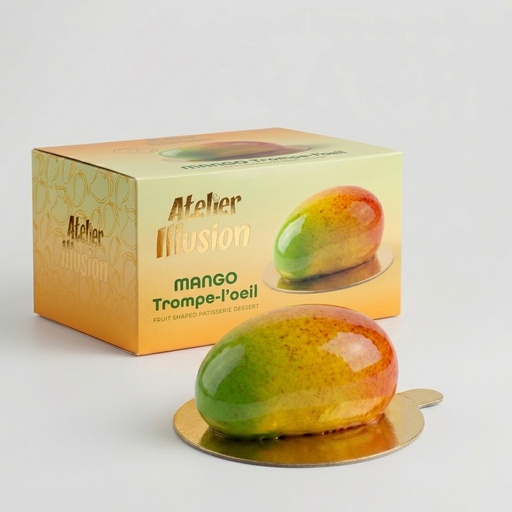
- Mango — mango cremeux, vanilla mousse, white chocolate shell
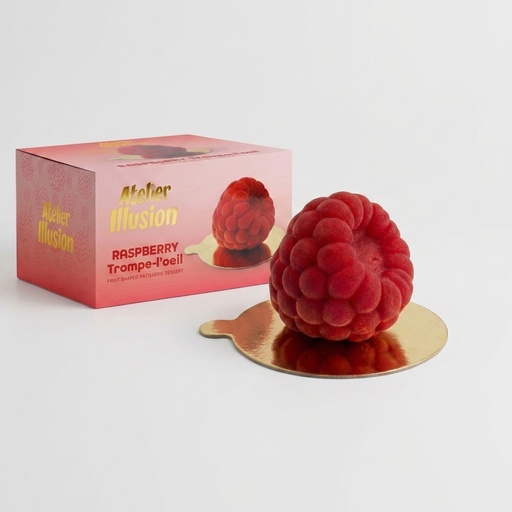
- Raspberry — raspberry cremeux, rose mousse, ruby-red velvet spray
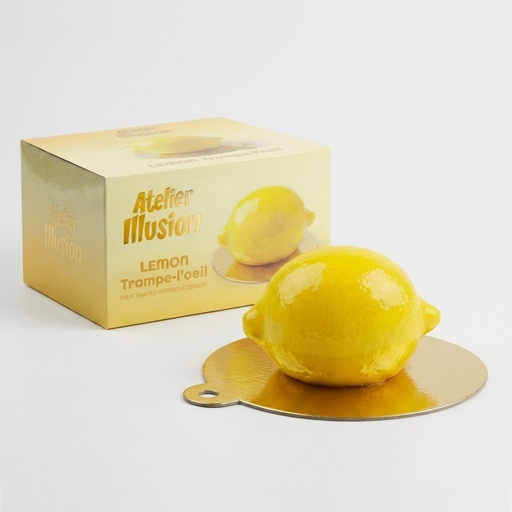
- Lemon — Amalfi-lemon cremeux, limoncello mousse, textured yellow shell
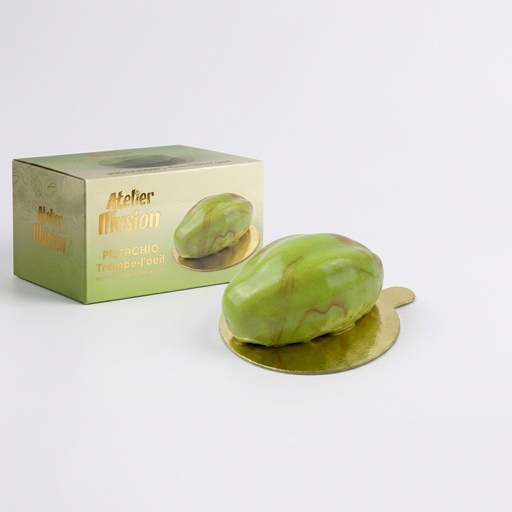
- Pistachio — Bronte pistachio cremeux, almond mousse
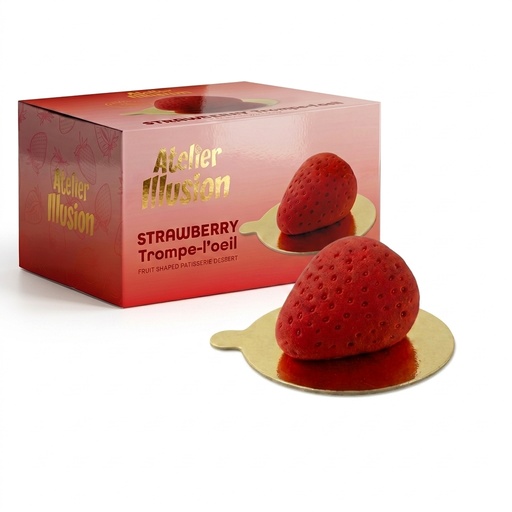
- Strawberry — strawberry cremeux, mascarpone mousse
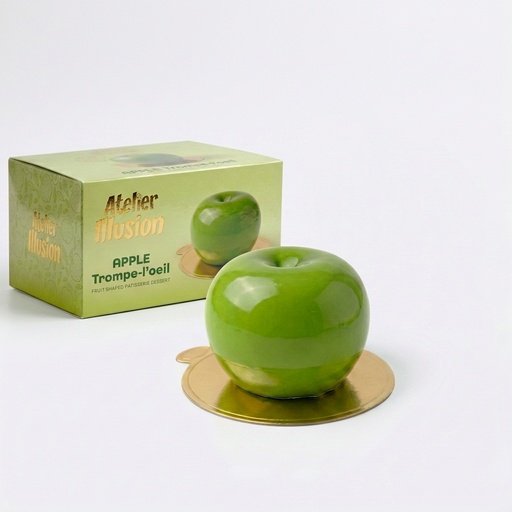
- Apple — Granny Smith cremeux, calvados mousse, hand-painted blush
- Ube & Strawberry — Philippine purple yam cremeux, strawberry mousse
- Peanut — salted peanut praline insert, milk-chocolate mousse, peanut-shell shape
- Matcha & Strawberry — Uji matcha cremeux, strawberry mousse
All references: 85 g monoportion, frozen at −18 °C, shelf life 12 months from production, CHF 5.90 per piece, no minimum order.
How to plate and serve a trompe-l'œil dessert
Three plating rules used by Le Meurice and adopted by Atelier Illusion:
- Thaw, do not temper: 25 minutes at +4 °C in the cold drawer, then plate directly. Room-temperature thawing breaks the velvet shell.
- Plate on a contrasting surface: matt slate or unglazed ceramic amplifies the realism. Avoid mirrored or busy plates.
- Serve with a complementary garnish: a single edible leaf, a brushstroke of fruit coulis, never a bed of garnish that competes for attention.
Atelier Illusion: the workshop behind the trend
Atelier Illusion is a pastry workshop founded in Vilnius, Lithuania in 2019 by a team of former-Le-Cordon-Bleu pastry chefs. The atelier produces under the technical direction of Karolis Vaitkus, who trained in the Cedric Grolet pastry lab in 2017–2018. Production is fully manual: every cocoa-butter spray pass is done by hand by a single technician, and every piece is quality-checked under daylight-balanced lamps before flash-freezing. Annual production: 1.2 million pieces. Distribution: 14 European countries. LAPA is the exclusive Swiss importer since January 2026.
Frequently asked questions
Are trompe-l'œil desserts gluten free?
Seven of the nine Atelier Illusion references are naturally gluten free (no biscuit base). Mango, raspberry, lemon, pistachio, strawberry, ube and matcha are GF certified. Apple and peanut contain a thin shortbread disc.
Can I refreeze a thawed piece?
No. Once the cocoa-butter shell has reached +4 °C the velvet finish loses its matt appearance on a second freeze. Order weekly in line with covers.
What is the minimum order for a Swiss restaurant?
None. LAPA delivers single-piece units alongside any other order. Standard 24-hour delivery from Embrach (ZH) covers the German-speaking and French-speaking cantons; 48-hour reefer delivery for Ticino.
How many pieces does the average Swiss restaurant sell per week?
Restaurants that introduce the line typically sell 20–35 pieces per week in the first month, growing to 60–80 once the dish starts circulating on Instagram. Fine-dining venues with tasting menus average 120+ per week as a dedicated dessert course.
Is the white chocolate shell vegan?
The shell contains cocoa butter, sugar and milk powder, so it is vegetarian but not vegan. A 100 % plant-based range is under development for Q3 2026.
How long does the velvet spray finish last on the pass?
90 minutes at room temperature without visual degradation. Above 22 °C the cocoa butter starts to gloss; plate to order during summer service.
Order Atelier Illusion trompe-l'œil desserts
LAPA is the sole Swiss distributor of the Atelier Illusion range. Nine flavours, 85 g monoportion, frozen at −18 °C, CHF 5.90 per piece, no minimum order, 24-hour reefer delivery from Embrach (ZH) to the whole of Switzerland. Browse the full collection on the LAPA pastry shop or visit the trompe-l'œil dessert landing page for the complete catalogue with photos, allergens and technical sheets.
Last updated: 27 May 2026 — LAPA finest italian food GmbH, Embrach (ZH), exclusive Swiss importer of Atelier Illusion since January 2026.
Products for Trompe-l'oeil desserts
Products mentioned in this article
- Strawberry trompe-l'œil dessert — The strawberry version of the exclusive Atelier Illusion range LAPA imports.
- Raspberry trompe-l'œil dessert — Ready-to-plate raspberry piece with the same hyperrealistic finish as the strawberry.
- Lemon trompe-l'œil dessert — A citrus option to diversify the dessert selection on fine-dining menus.
- Pistachio trompe-l'œil dessert — The nutty variant chefs pair with dark chocolate plating for contrast.
- Mango trompe-l'œil dessert — A tropical flavour to broaden the dessert selection beyond classic fruits.